Deep Research for Teachers – Google Gemini

Google Gemini has a feature called “Deep Research”, and this tool goes beyond the typical chatbot. This AI feature rapidly synthesizes extensive, detailed research into a cohesive, structured resource, allowing you to instantly generate the foundational text for a new unit of study. It can translate complex curriculum outcomes and guiding questions into complete, curriculum-aligned learning materials, significantly streamlining the resource creation process.

You can also see the list of references that it used to create the deeply researched output that it provides.

AI Prompting Tips for Teachers – Get Better Results

Prompting is not a difficult skill to develop, and certainly, it’s not a required skill for using generative AI, but a good prompt does improve your odds of receiving the output you are hoping for. 

This video suggests the CTR approach to prompting. Context, Task, Refinement. Tell the chatbot what the role is they are playing (e.g. an instructional designer for grade 9 social studies). Specify the task you want the chatbot to do (e.g. create a list of ten projects students could choose from to demonstrate their understanding of how urbanization can shift and shape a society.) Then tell the chatbot how you want the output to look (e.g. generate a list of the project choices along with a brief description of what the student would be asked to do). Including those three pieces of information will improve the result you get from the tool.

NotebookLM to Create Classroom Resources

A continuation from the introduction to Notebook LM where we create a video resource, an infographic, a mindmap, a report, and an interactive quiz.

Now, the real magic begins inside NotebookLM. We’ll show you how to take that dense history text and instantly turn it into usable student resources. Watch us quickly generate mind maps, infographics, instructional videos, reports, and design custom quiz questions based specifically on the curricular content we gleaned from Gemini’s Deep Research. This is how you shortcut hours of manual content creation and get straight to the art and science of teaching!

NotebookLM To Create Amazing Classroom Resources

You know how much time it takes to map out a new unit, especially when dealing with super specific curriculum points, or new curriculum such as we will be receiving soon for grades 7, 8, and 9? This video shows  you how to use Notebook LM to help generate beautiful and robust learning resources for your classroom. This example used the new Alberta grade seven social studies curriculum, covering content including the evolution of the NWMP including the legal details of the Statute of Westminster. 

This tool is essentially your instant research assistant. It quickly synthesizes complex historical information and organizes it into a coherent, chapter-ready text that aligns perfectly with your detailed learning outcomes. This means you skip the headache of deep-diving into sources and get a ready-made content foundation, giving you back valuable time to focus on designing the fun, engaging activities for your students.

Getting Started in Gemini – For Teachers

This video is for anyone who has not yet used AI as part of their practice of teaching. This simple chatbot has the potential to save you several hours of work each week. If won’t feed your dog, or take your kids to hockey practice, but it can help you come up with ideas for your classroom, or create new resources. 

This video provides some tangible ideas to get you started in Gemini.

So take a deep breath and dive in.

Chatbots are like having an expert in all things, right at your fingertips. Just remember to read through the output that it generates in case there are errors.

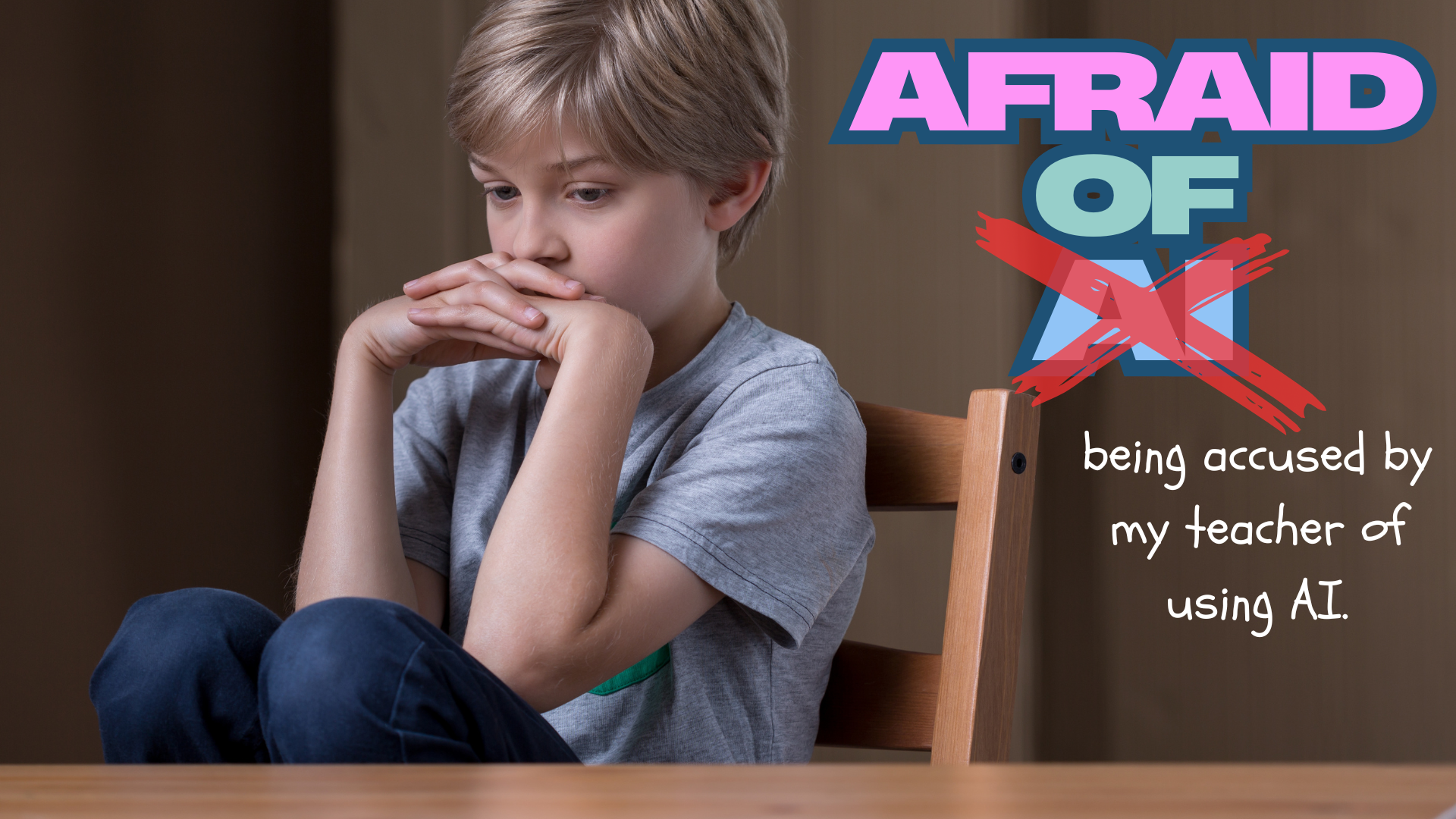
I’m Afraid My Teacher will Accuse me of Using AI

What About the Really Good Kids?

How much time and energy are teachers putting in to catching the cheaters without considering the ramifications of threats about AI punishments on the really good students?

When teachers give long threatening speeches about what will happen to students who use generative AI, what impact does that have on students who would never do something like that?

IT IS TERRIFYING TO THEM.

They fear being accused of doing something they did not do. They fear that their academic achievements could be attributed to a machine, and how will they ever convince their teachers (or their professors) that they did not actually commit this act of academic misconduct? They are afraid to even touch the tools in case someone believes that they cheated.

It’s Easy to Focus on the Problem

In our classroom spaces, it’s easy to go down the rabbit hole of trying to prevent students from using AI to complete their work.

  • How many students in your class do you think would actually do it?
  • What is the cost to your high flyers when the focus is solely on inappropriate usage of generative AI? 
  • If we teach students to fear AI, are we preparing them for a world where AI is becoming increasingly ubiquitous?
  • Who is going to teach this generation of students how they CAN use AI?
  • Have you ever examined the flip side of this question?

Unintended Harm

This post is not about shaming teachers for trying to take control of a new disruptive technology. Generative AI has disrupted the process of teaching and learning. It has brought new challenges and new considerations and we are all figuring this out together.

In the process of conducting my research for my Doctorate in education, I’ve been fortunate to benefit from conversations relative to both K-12 education and post-secondary education, and I’ve come to realize that there is harm to students who hold themselves to a high academic standard when teachers and professors threaten with ramifications that may come to pass if the teacher suspects the student of cheating on a written assignment.

Can we Find a Happy Medium?

Teachers, you do need to have a plan in place for those times that a student does engage in some academically dishonest behaviours. Just like you have a plan in place for other behaviour infractions.

If you’d like some thoughts that may be helpful as to how you might navigate this challenge gracefully, please take a look at my blog post titled AI Detection Tools; it does not advocate for using those tools – there are far too many false positives in that environment – but it offers a script that in almost any conversation will let you get to the bottom of the issue without burning bridges or destroying your teacher-student relationship.

These challenges can be navigated. Kids behaviour needs to be corrected sometimes. But we don’t need to let AI take dignity away from either us, our curriculum, or most important of all, our students.

AI Detection Tools

Students and Generative AI

When the Turing Test was passed in November 2022 with the release of ChatGPT, things changed for teachers; especially teachers who rely on the essay as being their “gold standard” for assessment. Suddenly students can utilize generative AI to complete written work for them, leaving some teachers floundering.

AI detection tools like Turnitin or GPTZero are tempting to use. The teacher takes the studen’s written work, loads it into one of these detection tools, and the tool confirms or refutes the teacher’s perception that the written work may have been completed by AI. Easy, right?

There are actually a few problems in this scenario. We’ll go through them one at a time here.

They don’t work

It has been shown repeatedly in the empirical literature that AI detection apps fail, indeed research reveals that these detection tools remain unreliable (An & James, 2025; Moorhouse et al., 2023). Classroom climate can be quickly flushed by wrongly accusing a student of utilizing generative AI for an assignment.

The teacher-student relationship takes time to develop and it serves a powerful pedagogical purpose in the classroom. When the relationship is destroyed, it impacts not just the teacher and one student, it can have much larger impacts than that, and it would be a genuine shame for this pedagogical tool to be obliterated by a false result from an AI detector.

It’s an “Arms Race”

Villasenor (2022) stated that in the arms race between writing tools and detection tools “the AI writing tools will always be one step ahead of the tools to detect AI text” suggesting that as fast as the detection tools can catch up to the generative AI tools, the tool students use to write will also be moving ahead. Van Dis et al (2023) noted the same, stating that “such detection methods are likely to be circumvented by evolved AI technologies and clever prompts” (p. 225). This alone suggests that these tools will not yield the result that the sleuthing teacher is seeking.

One Step Ahead

It should also be noted that students who would choose to use AI to complete their writing for them will likely also use social media apps like TikTok to gain new techniques to conceal or “humanize” the text they are intending to submit. There are many content obfuscation techniques that a student may put into play if they are the type student who would undertake such an action.

How Prevalent is the Problem?

It’s difficult to get a gauge as to the actual numbers of students who will choose this method of cheating on their schoolwork. The companies who make these apps to detect academic. misconduct have impetus to make claims that are higher than what the literature would indicate the incidences of actual cheating usage, as they are selling a product. It’s in their best interest to make claims about the extremely high numbers of “gotcha” documents as a means of convincing potential customers that their product is valuable.

Should Students use Generative AI?

According to Weber-Wulff et al (2023), “the use of AI tools is not automatically unethical. On the contrary, as AI will permeate society and most professions in the near future, there is a need to discuss with students the benefits and limitations of AI tools, provide them with opportunities to expand their knowledge of such tools, and teach them how to use AI ethically and transparently” (p. 2). One of the basic beliefs teachers hold is that they are preparing students for the real world, and to that end, it will be important for teachers to make their peace that AI is here to stay, and in order to appropriately prepare students for a future that will include AI, it will fall to teachers to adjust the means of accomplishing assessment in ways that are beyond the essay. This is not to say that we must abandon the essay as an assessmentt mechanism; but it does demand some innovation and rethinking on the part of teachers everywhere.

So yes, students should use AI when it is appropriate to do so, and teaching students HOW to use AI ethically and appropriately is going to fall on the shoulders of teachers to do this.

So What Should a Teacher Do?

AI detectors don’t work, and a false accusation can destroy the teacher-student relationship. So, what should a teacher do if they suspect that a student has utilized generative AI to write a document that is part of the class assessment?

This is actually where you need to lean on the teacher-student relationship, and it can actually be an opportunity to further build that relationship, believe it or not.

But you’re going to have to play “Columbo” for a few minutes.

(Apologies to the younger generation who are not so familiar with the old Columbo movies. Columbo was a popular American mystery TV series where the title character, a seemingly bumbling but highly intelligent LAPD homicide detective, solves murders; basically seeming like he just couldn’t put the pieces of the mystery all together, when in reality he was a homicide detective who appears unassuming and disorganized to hide his sharp, observant mind.)

What I mean is that you’ll need to have a conversation with the student you suspect of having used generative AI to write their work, and you may have to lay it on a little bit thick. Maybe try something like this:

The Script

Teacher: So, I read your essay over the weekend, and wow!!! Has your writing ever improved this year!! When I compare what you turned in for this essay to the work you were writing in September (pick your date/time in the past) I am blown away.

(watch for signs of discomfort; fidgeting, facial redness, beads of sweat, aggression)

Teacher: Here’s the thing though, it’s my job to teach and assess the curriculum, and because your writing has improved so dramatically, it’s my job to make sure that you understand the outcomes on the [insert name of course you are teaching said student] program of studies. So, I’m going to ask you some clarifying questions to ensure that your comprehension of the curriculum is at the level that this writing would suggest that it is.

(continue to watch for signs of discomfort)

Teacher: When you wrote [insert phrase from student writing that seems unlikely that they actually wrote] what did you mean? How did you draw that conclusion? [Ask any question that occurs to you with respect to the writing they submitted.]  Just be Columbo. Be confused, don’t reveal your cards, and don’t make an accusation. 

At this point you will be precipitously close to having the student confess.

Ask another clarifying question. If the student actually wrote the work, they should have no problem answering your questions, and you should be able to actually mean your compliments of their writing if they are able to answer your questions.

If the student cannot answer your questions, but will not confess, provide them with a sheet of paper and a pen or a pencil and ask them to write a summary paragraph that would allow someone who has never heard of [insert topic of the essay here] before to understand the fundamental premises of the essay. 

Again at this point, you’re on the verge of the truth here, and no accusation has been made to the student. 

Factor what they write down on that sheet of paper into their grade.

Scale this to your Entire Class

You may want to consider scaling this summary task to your entire class. Have every student complete this task in the moments after they submit their essays to you for grading. It matters not whether they submit their work to you in a LMS like Google Classroom, or if they print their work and hand it in. Ask every student in your class to take out a single sheet of paper and a pen or a pencil. They need to write a summary of their essay in class without the essay or a computing device. Just a pen and paper summary of what they just handed in to you. 

If you build the accountability in to your system, they’ll choose to use AI for someone else’s essay. You won’t be the target of this misbehaviour for long.
References

An, Y., & James, S. (2025). Generative AI Integration in K-12 Settings: Teachers’ Perceptions and Levels of Integration. TechTrends. https://doi.org/10.1007/s11528-025-01114-9

Moorhouse, B. L. (2024). Beginning and first-year language teachers’ readiness for the generative AI age. Computers and Education: Artificial Intelligence, 6, 100201. https://doi.org/10.1016/j.caeai.2024.100201

Van Dis, E. A. M., Bollen, J., Zuidema, W., Van Rooij, R., & Bockting, C. L. (2023). ChatGPT: Five priorities for research. Nature, 614(7947), 224–226. https://doi.org/10.1038/d41586-023-00288-7

Villasenor, J. (2023). How ChatGPT Can Improve Education, Not Threaten it. [EB/OL] [2023-05-14]. Available online at: https://www.scientficamerican.com/article/ how-chatgpt-can~improve-education-not-threaten-it/

ChatGPT – Getting Started Beginner’s Guide

ChatGPT is the AI tool you’ve probably heard the most about. OpenAI made big headlines after deploying this chatbot tool in November, 2022.

If you haven’t taken it for a test drive yet, and don’t want to ask someone to show you how to get started, this quick video will take you through setting up your account and entering your first prompts.

This is fun, it’s amazing, and it has the potential to reduce some of the burdens of teaching. You need to check this out as soon as possible!!

Let ChatGPT Teach You How to use ChatGPT

No one is an expert in AI. It’s too new. We are all learning what this is, what it means, and how to use it. There’s no reason to feel embarrassed for feeling a little bit out of sorts about this whole AI thing.

So, here’s the thing… if you want to learn at your own pace, and not feel embarrassed for being an artificial intelligence newbie, use ChatGPT to teach you how to use ChatGPT. I know that sounds really weird. ChatGPT-ception?? The video below will show you how to go about doing this.

And I also have a getting started with ChatGPT video that shows you how to find it, and how to get started.

Human vs AI: 5 Tips for Detecting AI-Generated Text

A quandary all teachers are facing in 2024. How can we be certain if a student has used AI to write an assignment that has been submitted for grading. 

Sometimes it’s our first instinct to look to technology to solve challenges that technology has created. In other words, we want a utility that can assure us either way with respect to the potentially plagiarized work. These tools exist, but the reviews are iffy so far.

So, here are 5 tips for teachers to try to identify student essays that were generated using artificial intelligence tools. The sixth tip suggests using online plagiarism detection tools. The 5 tips I offer in this video involve human inspection, and trusting your teacher eyes.

Isn’t ChatGPT Just Another Search Engine?

You ask it questions. It gives you answers. That’s a search engine, right?

Not exactly.

ChatGPT being a chatbot, it will converse with you. It doesn’t provide you with a bunch of pertinent websites that you need to read through and summarize in your head (or on paper). It answers your question, like a human would. It composes sentences, and responds using human-like language. Further, you can ask follow-up questions to the chatbot and it will respond to your follow up questions. And the follow up question could be asked literally months after the conversation, and ChatGPT will respond like no time has passed. 

It’s worth trying it out!!

Quick Win #4 – Report Card Comments with ChatGPT

How can you say something meaningful in just a few words? Report card comments are like the old Twitter; limited. Saying something valuable in just a few words is challenging.

And let’s be honest, report card comments are the last thing we input, after tallying all the grades, and producing the report card marks. So, really, after I’ve taught all day, coached, made supper, planned tomorrow, marked, and prepped the report card grades, then I’m going to do my report card comments.

I am definitely not at my best at the end of the day, and my brain may struggle to come up with succinct comments. Yet, I want my comments to not sound as if my 10:00 at night brain were writing them. And, further, I don’t want to write the same thing over and over… “{student name} is an excellent student” “{student name} struggles to focus on a regular basis” They don’t really communicate much of value to the parent reading the report card.

What if I had an assistant? What if I had an assistant at my side with computational (thinking) speeds that are impossible for a mortal such as myself to possess?

Enter Artificial Intelligence.

ChatGPT is free, and it is an INCREDIBLE brainstorming assistant! Just try asking it for 25 report card comments for a student with ADHD. You’ll have so many different ways to phrase the comment, that you might even feel inspired! Try asking it for report card comments for a student who is exceptional at creative writing. Ask it for report card comments for a student who is always helpful. And once you have a list of comments, you can converse with ChatGPT to adjust or change the ones you like to be even more accurate.

Teachers take on a lot. Teachers are always being asked to do more. Care for students. Counsel them. Sanitize everything during a global pandemic. Teach with trauma-informed practices. Ensure that your classroom abides by assessment for learning. Provide an inclusive learning space. Differentiated. Offer personalized learning. Keep students engaged and interested. There’s always one more thing to fall onto the shoulders of teachers.

Maybe with artificial intelligence teachers can get a win. Maybe instead of it being one more thing that teachers have to learn and know about, perhaps it can be a positive. Maybe it can help with some of the rigours of teaching in the twenty-first century.

There is nothing wrong with having an assistant help you to say what you want to say, how you want to say it. You can have a creative assistant. A brainstorm buddy. There is now help for you, tired teacher!

Quick Win #3 – Novel Study & Project Ideas

Teaching is an amazing career. The classroom is a fun, energizing place to be. But coming up with new, creative, innovative ideas for projects can present a challenge. Our human brains can only process at the rate they think. Wouldn’t it be nice to have an idea factory at your fingertips to come up with new, great, fun, engaging ideas for your classroom? Would an assistant be helpful?

Enter AI! ChatGPT is an incredible tool for brainstorming new ideas (and rubrics for grading) to use in your classroom. That unit that you’ve been wanting to refresh, but haven’t had the inspiration to bring to bear? Go sit and chat with ChatGPT for a few minutes, and be prepared to be illuminated, excited and inspired.  Put the fun back into teaching!

Quick Win #2 – ChatGPT for Test Creation

Assessment – it’s a big task for teachers to undertake, and an even bigger task when we allow students to take a re-test under the assessment for learning philosophy. Can ChatGPT offer some help to teachers who are wanting to improve their assessments? Can ChatGPT make a test, that you then edit to ensure the curricular alignment of the questions being asked? You bet it can!

Let me show you how to use this tool to improve your evening plans. Instead of taking two hours to craft a new test, let ChatGPT start it for you, and then you can do something to fill your own bucket. Teacher wellness matters, and ChatGPT offers a myriad of ways for teachers to produce high-quality content much more quickly than we ever could before.

Quick Win #1 – Can ChatGPT Differentiate Reading Levels?

One of the biggest challenges in teaching is differentiation. In an era where we value inclusion, providing resources that are at the appropriate reading level for a classroom filled with students can be difficult. Artificial Intelligence to the rescue!! With ChatGPT, you can change the reading level of text that you copy-paste into the chatbot. 

Imagine you are teaching grade 8 science, but you have two students who are reading at about a greade three level. Providing them learning materials written at a grade 8 level does not reach them at the reading level they are functioning at. If they can’t read it, they can’t study it. Enter ChatGPT to help you scale down the reading levels of the content you use in your classroom.

It’s important to be aware who holds the copyright of any text that you run through a Chatbot. It remains unclear where the data that is entered into the chatbot actually ends up, and it is important to be vigilant as it pertains to intellectual property when we are utilizing new artificial intelligence tools.

Pin It on Pinterest