Ways to use AI in K-12 Classrooms

The empirical literature outlines a number of ways that artificial intelligence (AI) might be used in K-12 education. Despite these categories of use being identified as researchers as viable uses for AI in the K-12 classroom, many teachers are either unaware of these new resources, or they are unfamiliar with how to use these new tools, and the result is the same: at this time, they are either underutilized, or not utilized at all.

Regardless of the ubiquity (or lack thereof) of the use of these tools, we’ll  briefly outline some of the potential value that the academy suggests AI may bring to the K-12 environment.

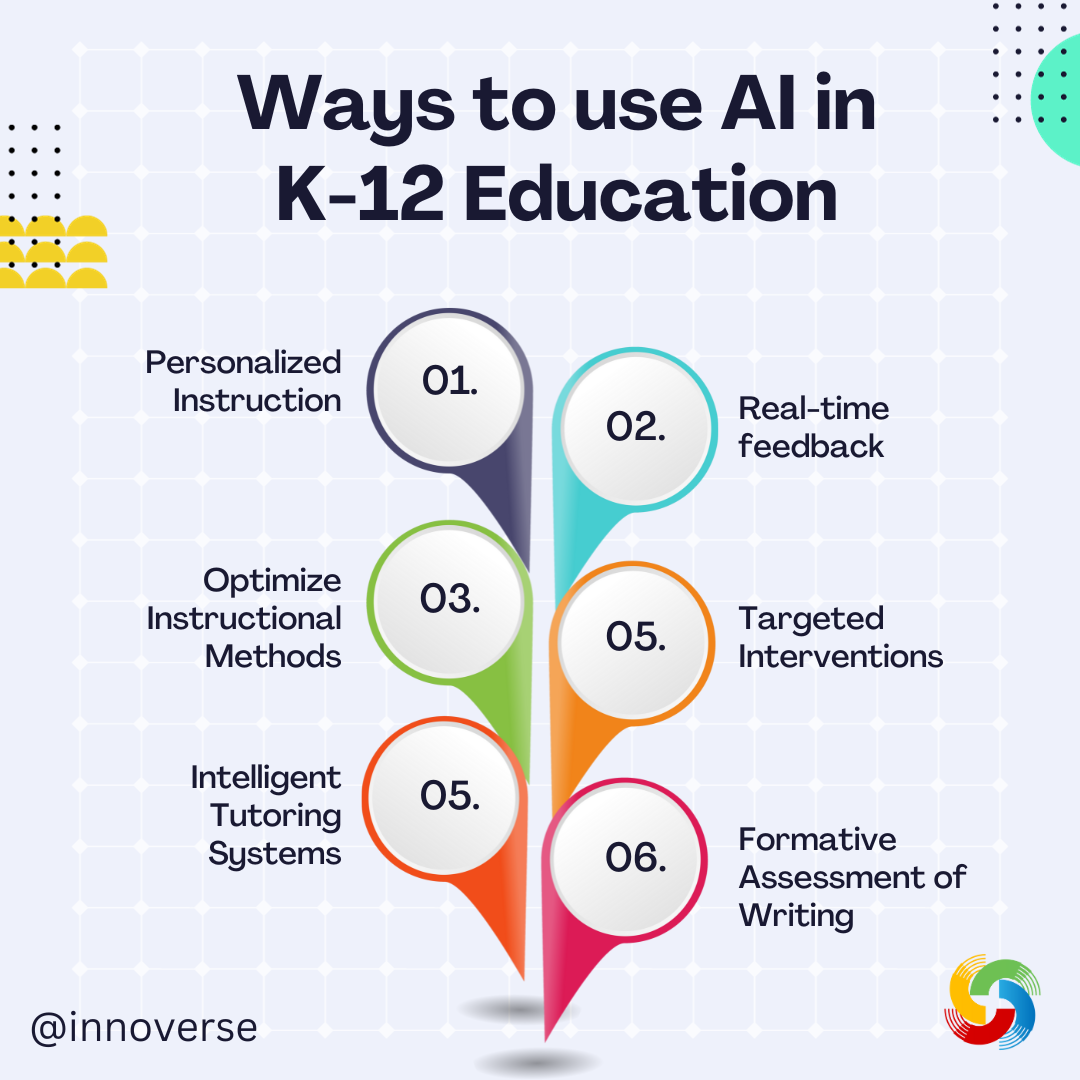
Despite a paucity of research specific to K-12 education, the literature is filled with examples of uses for artificical intelligence in the K-12 classroom. For example, Holstein et al (2018) used Lumilo as mixed-reality glasses that allowed the educator to see the physical data of the student’s body language and also provided an additional digital layer over each student  (Crompton & Burke, 2022, p. 117).  AI programs, such as CyWrite, WriteToLearn, and Research Writing Tutor are being used to unpack and analyze student writing and provide feedback to the educator (Hegelheimer, et al. 2016). Crompton and Burke (2022) made reference to AI tutors literature review, noting that they provide one-to-one support for students, with tutoring matched to the student’s cognitive level followed by immediate, targeted feedback (Luckin, et  al. 2016). Examples of AI tutors include systems, such as ACTIVE Math, MAThia, Why2Atlas, Comet, and Viper which are used for a variety of subjects and grade levels (Chassignol et al. 2018). BERT, RoBERTa and XLNet are primarily focused on understanding the underlying meaning of text and are particularly useful for tasks such as sentiment analysis and named entity recognition  (Lund & Wang,  2023, p. 27).

So, the literature is currently outlining some uses for artificial intelligence that, in my estimation, and from my vantage point of working as the coordinator of educational technology, are not yet being used by teachers who are in front of our K-12 students. We are not going to endeavour to locate and test the affordances that are mentioned in the literature, but rather, we acknowledge that there is progress made in this area on a daily basis, and as applications involving artificial intelligence become more ubiquitous and/or more affordable, their usage will be inevitable in our K-12 classrooms worldwide.

References

Chassignol M, Khoroshavin A, Klimova A, Bilyatdinova A (2018) Artificial intelligence trends in education: a narrative view. Procedia Comput Sci 136:16–24. https://doi.org/10.1016/j.procs.2018.08.233

Crompton, H., & Burke, D. (2022). Artificial intelligence in K-12 education. SN Social Sciences, 2(7), 113. https://doi.org/10.1007/s43545-022-00425-5

Hegelheimer V, Dursun A, Li Z (2016) Automated writing evaluation in language teaching: theory, development, and application. Comput Assist Lang Instr Consort J 33(1):2056–9017

Holstein K, McLaren BM, Aleven V (2018) Student learning benefits of a mixed-reality teacher awareness tool in AI-enhanced classrooms. In: Rosé C, Martínez-Maldonado R et al (eds) Proceedings of the 19th International Conference on Artificial Intelligence in Education (AIED 2018). LNAI 10947 Springer, New York, pp 154–168

Luckin R, Holmes W, Forcier LB, Griffiths M (2016) Intelligence unleashed: an argument for AI in education. https://www.pearson.com/content/dam/corporate/global/pearson-dot-com/files/innov ation/Intelligence-Unleashed-Publication.pdf.

Lund, B. D., & Wang, T. (2023). Chatting about ChatGPT: How may AI and GPT impact academia and libraries? Library Hi Tech News, 40(3), 26–29. https://doi.org/10.1108/LHTN-01-2023-0009
Start at the Beginning

Let’s start at the beginning (more or less) with Artificial Intelligence in K-12 education. The starting point I will identify will be the launch of ChatGPT, as it is the point of awareness for the majority of the population of our planet, that AI has arrived, and it is here to stay. This is not to say that there have not been components of AI in K-12 education prior to ChatGPT, certainly, there have been. But ChatGPT ‘s launch represents a fundamental change in the way that AI is understood, viewed and mentally represented by the majority of people.

At the end of 2022, OpenAI launched a chatbot, named ChatGPT, that within five days attracted over one million users (Doshi et al., 2023, p. 6; Yu, 2023, p. 01). ChatGPT revolutionised people’s understanding of AI simply by being so very easy to use. The ChatGPT screen appears very similar to a search screen such as that of Google, but the space for the user to type in appears at the bottom of the screen. It also, unlike a search engine, provides some suggestions for the user in terms of interacting with the chatbot.

The layout of ChatGPT is so minimal, that it becomes obvious to new users how they are to proceed in order to interact with the artificial intelligence.

It’s important to know that the free version of ChatGPT (GPT-3.5 as shown at the top of the image), as of the date of this blog post, has been trained on data up to 2021. (The paid version, GPT-4 has been trained to a more recent point; According to the company who created ChatGPT, OpenAI, it has limited knowledge of world and events after 2021. The model has been trained on a diverse range of texts, including books, articles, and websites, allowing it to understand user input, generate responses, and maintain coherent conversations on a wide range of topics  (Chan & Hu, 2023, p. 2). When you ash ChatGPT a question, you receive a response that reads as smoothly as if a human had considered your question and took time to craft a response. Without taking a deep dive into the technical details, it is worth noting that the chatbot called ChatGPT was trained using more than 175 billion parameters (Chan & Hu, 2023, p. 2). This massive training is how, despite that it is actually not connected to the Internet (OpenAI, 2023), it is able to construct responses that “feel” human.

References

Chan, C. K. Y., & Hu, W. (2023). Students’ voices on generative AI: Perceptions, benefits, and challenges in higher education. International Journal of Educational Technology in Higher Education, 20(1), 43. https://doi.org/10.1186/s41239-023-00411-8

Doshi, R. H., Bajaj, S. S., & Krumholz, H. M. (2023). ChatGPT: Temptations of Progress. The American Journal of Bioethics, 23(4), 6–8. https://doi.org/10.1080/15265161.2023.2180110

OpenAI. (2023). What is ChatGPT? https://help.openai.com/en/articles/6783457-what-is-chatgpt

Yu, H. (2023). Reflection on whether Chat GPT should be banned by academia from the perspective of education and teaching. Frontiers in Psychology, 14, 1181712. https://doi.org/10.3389/fpsyg.2023.1181712

Researching AI in Education

 My blog has been quiet for a while. I’ve been grappling with my research ideas, and passions. So much so, that I have come to term this phase as my mid-degree crisis. I’ve made the decision to change my focus to a currently pressing topic in education; Artificial Intelligence.

I am still sussing out the actual research question, but I want to try to look at this new tool/resource as more than just a new challenge to the classroom, but rather through a lens of teacher wellness. How can we use this new tool that is growing more ubiquitous by the day to perhaps take something off the plates of teachers? 

These are the conversations I am hoping to have with teachers this school year while I work through the literature review portion of my dissertation, and hammer down the official research question and associated methodologies.

Research – Preliminary thoughts

My research topic is an evolving decision. I have entered my doctoral program with a number of potential research interests. As I’ve already blogged, the one that keeps coming back around is the concept of strengthening the teacher-student relationship with the use of technology. 

I have a loose hypothesis in my head that there is something to the one-on-one nature that certain digital technologies can offer that relationship. I’ve seen it play out positively a few times over recent years, and I feel like there is more there than meets the eye. Of course, it has issues such as boundaries, appropriateness of communication and the documentation of these things, but those topics can be more broadly tackled as my research unfolds.  For the summer of 2022, I am starting by taking a step back to first look at the teacher-student relationship, and the pedagogical role it plays. Then I will open it up slightly to include digital technologies as they have been previously used and studied.

Research Interest

As I reflect on my research, I realize that my passions have evolved organically from over two decades spent in the classroom in K-12 learning.

I am specifically interested in using technology and ubiquitous connectedness to improve the teacher-student relationship.

To get to that place, I need to take a few steps back, and find out what the literature tells us about the importance of that relationship in the career as “Teacher”. I know from my 23 years in the classroom that the relationship between the teacher and each student is important, and any steps that can be taken to improve the quality of that connection will improve outcomes for the student.

But I do not know the specifics of this. Does a good relationship with the teacher improve academics? Does it change in-class behaviour? Does it alter the student’s commitment to the classwork? Are there any changes to out-of-class behaviours such as homework completion or test studying?  My initial research needs to seek answers to these questions.

I realize that as I read the literature, and as I find answers or partial answers to that early list of questions, I am likely to have more questions emerge. This is a journey, and I am only setting my feet onto the first part of this path. The years ahead will reveal the clarity of where this path will go.

That said, the next phase of my inquiry will move into the teacher-student relationship when there is a screen involved. Two years ago our planet was thrust into a circumstance of emergency online learning, and the relationships that had existed in the face-to-face classroom were moved online. Teachers were not prepared for this shift, but with grit and perseverance, they did their best to make it work. Clearly there is data to be found in the pandemic reality; some data may be relevant to my research.

As of today, my interest for my doctoral research will in some way fall into the idea that perhaps teachers can leverage the power of technology, and mobile technology to improve the quality of their relationships with their students. I have personal experience as a teacher that suggests there may be something to learn here; I’ve additionally seen this play out with other educators, so now I want to know more. Actually, I need to know more.

The way that we use our technology continues to evolve. What was the intended use for a particular technology when it was first deployed may not be the way that it actually used once it is in the hands of humans. An illustrative example of this would be Facebook. It was designed for humans to connect to and communicate with other humans. However, it did not take long before businesses were starting Facebook profiles to connect to their clients. The programmers at Facebook had to reenvision the product, and “pages” and “groups” were created to address this style of usage.

I think this is a topic worth researching because we live in an interconnected world, and at times, technology can create the perception of a more distracted or distant relationship to others, yet we are more connected to others than we have ever been. How can we utilize the mobile technologies that we regularly engage with to better support learners, and to facilitate stronger relationships? We know that the relationship between teacher and student is important, but some students can be difficult to build rapport with. Can digital technologies bridge any of those gaps? Can mobile technologies strengthen positive relationships? Can they provide the starting point for relationships with students who present greater challenges in our classrooms? How can we harness the power while mitigating the risks?

Song, H., Kim, J., & Luo, W. (2016)

When Song, Kim, and Luo (2016) conducted their research into the role of teacher disclosure in the teacher-student relationship in online classes, they conducted their work in a mid-western American university, surveying 534 undergraduate students. They demonstrate by citing previous research that it is well understood in education that the teacher-student relationship is an important factor in student success. To acquire accurate data for their analysis, they selected one aspect of teacher interpersonal communication; self-disclosure, and to obtain data regarding learning they focused on two dependent variables; the perceived knowledge gain and class satisfaction of the students. They used an identical questionnaire for face-to-face (FtF) learners as they did with online learners in order to compare the two environments in a compatible manner. To further strengthen the robustness of the data they were seeking, participants were recruited from only large introductory communication courses. Age was included as the control variable.

The first survey was conducted with a focus on face-to-face learning, and they note that among the survey respondents there were more females than males with the ratio being approximately 70% females. The second survey was conducted a semester later and focused on online learners. The same survey was administered to the online learners (this time the female percentage was only 55) a semester later. The sample groups were comprised of different students so as to avoid test sensitization. Most students in the sample had taken both online and FtF classes at the college where the study took place, allowing researchers to make systematic comparisons of the two environments. 

Findings of their study revealed that the impact of teacher self-disclosure on teacher-student relationship is stronger in online classes as compared to face-to-face classes. They assert that it has a higher implication in the online environment because there are reduced cues is the remote environment that facilitate easy and natural self-disclosure. Their statement “online environments [that] may preclude teachers from revealing even basic information such as demographics (e.g., age, ethnicity), voice or personality, which can be readily available in FtF classes” (p. 441)  indicates that no video lectures are factored in to their definition of online learning, neither in the form of flipped classroom pre-recorded lectures, nor through video conferencing applications such as Skype or Zoom. They also explicitly stated that their data showed that teachers disclose themselves significantly less online than they do in the FtF classroom. 

This research was novel in that the majority of previous research on topics of relationships in the online environment was completed using applications whose main purpose was the forming of relationships (social networking sites or dating sites). As online classes are not generally centered around the building of relationships, there was a gap in the research that Song et al. have begun to fill in with this study. 

Their study suggests that teachers should be mindful of the absence of their personal self-disclosure in the online classroom in order that they take deliberate steps to include this critical piece of human interaction when instructing in the online environment. They do not suggest what type of information should be revealed in order to facilitate this disclosure and subsequent relationship improvement. They also acknowledge that this area is one that requires further study.


References

Song, H., Kim, J., & Luo, W. (2016). Teacher–student relationship in online classes: A role of teacher self-disclosure. Computers in Human Behavior, 54, 436–443. https://doi.org/10.1016/j.chb.2015.07.037

How do we Learn?

This was a tough first assignment; I truly do not know the answer. So here is my best shot at it as of today.

Learning is a complex, multi-sensory, brain activity that involves the writing of data into the synapses of our brains. Learning involves relationships and connections; both between the learner and the content, as well as between the learner and the instructor. We learn when something becomes meaningful to us; when something is situated in our lives and when the relevance is obvious, we are predisposed to learn. In the absence of the situation, learning can occur, but it is generally shallow, facile and largely temporary. When we engage with contextually relevant material, we are hard-wired to learn. The moment we take our first breath after birth, learning begins. Infants know nothing beyond communicating, (with one tool only, a cry), their most basic of needs. But the processes of learning commence immediately at birth. Our senses engage with the world around us, and each time we encounter something new, we observe, we categorize, we connect, we label, and we write the data, both the correct and incorrect data, to our memories.

Learning is not solely a rational process. Emotion influences motivation, which influences learning. Maslow before Bloom. If the bottommost needs from Maslow’s pyramid are not being met, educators observe that the child (or adult) is not available to learn. So we try with breakfast programs and other supports to maximize the odds of all children being equally ready to learn.  It’s infinite combinations, working in infinite patterns, while we try to discern how they tie together.

Pin It on Pinterest