
Citizenship, Critical Thinking, Problem Solving

Real life has an interesting way of presenting opportunities that can be embedded into instruction.

This fall, I’ve done a wholesale change to my grade eight technology program. I’ve launched a course with design learning at the heart of the project. The upfront costs were significant, but not impossible for a junior high school if we proceed strategically. To date I’ve invested in a Cameo cutter (and much vinyl for the cutter), a 3-D printer, some raspberry Pi kits, a Makey Makey, Bloxels, and Ozobots coding robots.

The Cameo cutter has allowed us to begin to advertise our skills, and attempt to take some measures to recoup the cost of the consumables necessary to run an effective design program. To that end, we’ve created a Facebook page called 110 Design (My classroom is room 110, so should someone else take over the program, the advertising is easy to continue forward).

In the past month, our town has launched a new system for collecting garbage, and it involves standardized “black garbage bins” that all citizens must use. There has been a huge backlash from the residents in this town, and we struggled to make sense of the negativity. As we inspected the conversations on the local Facebook groups; it occurred to us that perhaps the underlying concern was in the potential to lose one’s garbage bin should a wind kick up. It’s a fact that our area of the province can be quite windy at times; particularly in the spring.

To take a small litmus test as to whether we were on the right track with this thought, I posted an offer on the local Facebook groups to provide small, standardized vinyl labels to be affixed to the top of the bins, for the cost of $5.00, providing the address of the residence the bin belongs to. The response was overwhelmingly positive; and requests started to flood in.

The first challenge to students was to find a means of tracking the orders. Students were presented with the challenge via Google classroom and were given the opportunity to work alone, in pairs or with a group of three.
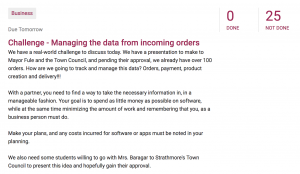
We settled on using Google Forms, as we are a GSuite school and there is no cost to us (or to our profit margin) to utilize it to collect the information. Next we sent an email to our Mayor asking if we could present our idea to Town Council at their first available opportunity. Within an hour of sending the email, we received this response:
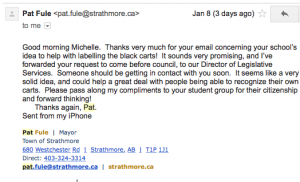
It reads:

Good morning Michelle. Thanks very much for your email concerning your school’s idea to help with labelling the black carts! It sounds very promising, and I’ve forwarded your request to come before council, to our Director of Legislative Services. Someone should be getting in contact with you soon. It seems like a very solid idea, and could help a great deal with people being able to recognize their own carts. Please pass along my compliments to your student group for their citizenship and forward thinking!
Thanks again, Pat.

Students are so proud to be part of the solution to a local issue, and are incredibly eager to have the opportunity to present our plans to town council, and then we will begin the process of creating and delivering. They will certainly have a challenge in monitoring which addresses are complete, and planning how we are going to collect the $5 per label from the citizens without putting pressure onto our school’s secretaries. With only having mentioned it once on the local Facebook page and once on our school’s Facebook page, we already have over 100 orders for these bin labels.

We have much more thinking yet to come!!!

Assessment – Challenges and Ideas…

A few days ago, I had the opportunity to tour more Makerspace environments in Calgary, Alberta.  Unfortunately, one of our tours got canceled; the one which was set for Roots2Stem, as they were under the impression we were seeking to replicate their makerspace.  I had actually been intending to use their Makerspace as the “grande finale” field trip to close off a series of maker dates in our junior/fledgling Makerspace in my own school, but alas, it is not to be.  I am certain there is no way my itty bitty junior high budget could ever compete with their capitalist venture, but their message indicated, in no uncertain terms, that if we were going to “copy their space”, they were not willing to share their innovation with us.

But I digress.  I came away from these tours with much more than just inspiration and insight into facilitating the maker movement, I also came away with a new insight into assessment in a technological environment.  I had the opportunity to speak with Ken Christensen at Robert Thirsk High School in Northwest Calgary.  His take on assessment in our field was what he terms “progressive” assessment as opposed to “outcomes-based assessment.  Replication -> Modification -> Innovation. Essentially, if you can replicate what the instructor teaches, your grade falls around the 75% range.  If you can take the learning and modify it, you move your assessment into the 85% range.  And finally, taking the learning and applying it to innovate with something new, or to solve a problem moves you into the 95% range.  Of course, these numbers are all “give or take” and are based on each scenario independently and uniquely, but it gave me a new take.  Outcomes-based assessment in technology and in maker environments is extraordinarily difficult to accomplish.  Many things, are either “can” or “can’t”, with not much in between the two.  Bringing the skills into a larger framework of problem-solving and innovative thinking allows for a broader spectrum of achievement.

CBE & CCSD Maker tours

What a mind-blowing day!!  My Collaborative PD Day involved tours of three makerspaces in Calgary. Two with the Calgary Board of Education and one with the Calgary Catholic School District. A day spent with three incredible educators is nothing short of amazing.

The morning started at Midsun Junior High School in the southwest of Calgary.  They are reworking their library to operate as a Learning Commons and Makerspace. I met with the amazing Amber Mazur and we discussed coding and the Raspberry Pi – and using the book Adventures in Raspberry Pi as a guided reading endeavour. (What a brilliant idea by Amber!). We discussed furniture choices and space reallocation within the library. We looked at the inquiry-based learning taking place throughout the school. And we debated the question “what is the difference between design-based learning and makerspaces?”

Midday took me to Calgary Catholic Board’s  St. Augustine School school. I spent time chatting with brilliant Marylee about the maker movement in CCSD and the #MakerMarch design challenge she has issued for any schools in their board to participate in. We talked about the logistics of makerspaces, the re-envisioning of the library space, and teacher reactions to the changes.

The day finished up at Nose Creek School learning from the remarkable Steve Clark. We looked specifically at robotics and 3D printing. We discussed the positives (there are many) of 3D printing in schools as well as the challenges (they do exist).

Many thanks to Amber, Marylee and Steve for making my PD day so rich with information and learning!


Pin It on Pinterest