
Complete Grade 9 Social Studies Resource for Alberta’s New Curriculum

The new junior high program of studies for Social Studies in Alberta is set for optional implementation in the 2026-2027 school year.

This is a 266 page book, designed to be the backbone of the new Systems section of the new Alberta grade 9 Social Studies program of studies. The book includes reading passages to teach the content, activities for students to engage in the learning process, and almost 100 pages of teacher notes, grading advice, answer keys and exemplars.

 Every one of the KUSPs (Knowledge, Understanding, Skills and Procedures) is covered in this ideologically-neutral book.

A Complete Grade 9 Social Studies Resource for Alberta’s New Curriculum
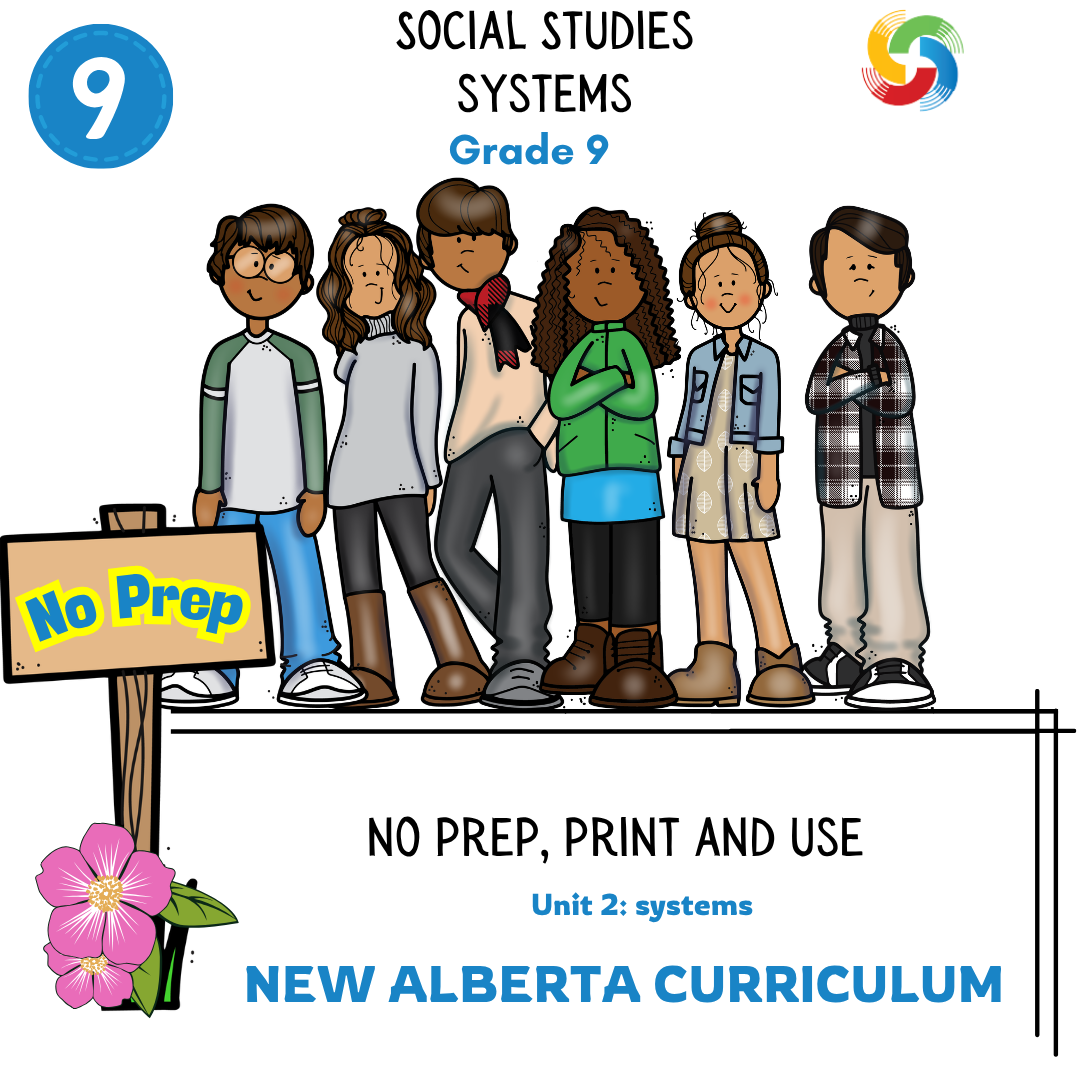
The Systems Segment — Fully Covered, Print-and-Use, 266 Pages

If you have spent any time searching for resources for Alberta’s new Grade 9 Social Studies curriculum, you already know the problem: there is almost nothing out there.

The new Alberta Program of Studies for Grade 9 Social Studies is not a revision of the old curriculum — it is an entirely new document with entirely new driving questions, new outcomes, and a new organizational structure. Resources built for the old curriculum do not transfer. The familiar units on globalization, quality of life, and natural resources are gone. What exists now is a three-segment structure — Time and Place, Systems, and Citizenship — and the resources to support it are, at this moment, extraordinarily scarce.

That is exactly why we built this workbook.


What is the Alberta Grade 9 Social Studies New Curriculum — Systems Segment?

For teachers who are still getting oriented to the new program, here is a quick overview of what the Systems segment covers.

The Systems segment addresses a single overarching understanding: evaluating processes and structures of organizations builds understanding of decision making in the world. It does so through two driving questions:

1. How did economic changes transform Canada into a modern economy?

This driving question asks students to examine Canada’s economic history from the 1920s through the present — including the causes and consequences of the Great Depression, the post-war industrial boom, the growth of suburbs and urbanization, and Canada’s deep trade relationship with the United States through agreements like NAFTA and CUSMA.

2. How is power organized and exercised in Canada’s system of government?

This driving question asks students to analyze how Canada’s governmental structures work — responsible government, the parliamentary process, how laws are made, ridings and representation, federal and provincial powers, the court system, and the Charter of Rights and Freedoms.

These are rich, complex topics. They require substantial reading, structured analysis, and the development of written argumentation skills. And they require resources — which, until now, have been nearly impossible to find for Alberta’s new curriculum.


Introducing the Grade 9 Social Studies Systems Workbook from Innoverse

This 266-page, print-and-use workbook is a complete resource for the Systems segment of Alberta’s new Grade 9 Social Studies program. It was built from the ground up for the new curriculum — not adapted from older materials, not a rough approximation. Every section, every exercise, and every assessment tool was designed specifically around the new outcomes.

What’s Inside

Ten complete content sections spanning both driving questions:

  • Section 1: The World Before the Crash — the 1920s economy, overproduction, speculation, and the collapse of global trade
  • Section 2: The Great Depression — unemployment, deflation, the Dust Bowl, relief camps, the On-to-Ottawa Trek, and government responses including public works, social welfare, and deficit spending
  • Section 3: Canada After the War — post-war industrial sectors including automobile manufacturing, petroleum, pulp and paper, and hydroelectric power; the baby boom; urbanization and suburbanization
  • Section 4: Canada and the United States — the historical roots of the trade relationship, the Auto Pact, the FTA, NAFTA, CUSMA, free trade debates, and economic interdependence
  • Section 5: Responsible Government and Canada’s Parliament — the confidence convention, the three parts of Parliament, Orders in Council, regulations, and how government acts beyond Parliament
  • Section 6: How Laws Are Made — the full seven-stage legislative process, parliamentary debate, the committee stage, emergency legislation, and when government acts without Parliament
  • Section 7: Ridings, Representation, and Voting — first-past-the-post, electoral redistribution, the history of suffrage in Canada, and the three roles of an MP
  • Section 8: Federal vs. Provincial Power — the division of powers, fiscal federalism, equalization payments, natural resource jurisdiction, the National Energy Program, the carbon tax Supreme Court decision, and western alienation
  • Section 9: The Courts — the rule of law, judicial independence, the court hierarchy, criminal vs. civil cases, judicial review, landmark Supreme Court decisions, and Indigenous rights jurisprudence
  • Section 10: Rights, the Charter, and Citizenship — all categories of Charter rights, the notwithstanding clause, citizenship rights and responsibilities, and the Charter’s impact on Canadian society

Student Activities — Varied, Rigorous, and PAT-Aligned

One of the most important features of this workbook is the deliberately varied mix of student activities. Rather than relying on the same format section after section, the workbook uses a range of exercise types designed to build different skills — and to keep students engaged across a three-month unit.

Activity types include:

Graphic organizers — cause webs, two-column and four-column comparison organizers, sector profile tables, government response organizers, and court hierarchy flowcharts that help students organize complex information before writing about it.

Political cartoon analysis — using a structured five-step framework (Identify, Interpret, Connect, Evaluate, Perspective), students analyze original editorial cartoons on topics including Canada-US trade relations and federal-provincial resource conflicts. This format directly mirrors the visual source analysis skills tested on the PAT.

Source analysis — each section includes at least one primary or constructed source — a first-person oral history account, a simulated political statement, or a real court decision summary — accompanied by structured questions that build historical and civic thinking skills.

Case studies with decision-making scaffolds — students work through realistic dilemmas faced by MPs, governments, and citizens, identifying perspectives, tensions, options, and trade-offs before making a recommendation. These exercises develop the kind of multi-perspective thinking the PAT extended response requires.

Vocabulary in context — rather than simple glossary fill-ins, students encounter key terms in the specific context in which they appear in the reading and must explain their meaning and use them correctly in original sentences.

Socratic seminar and fishbowl preparation sheets — structured pre-discussion organizers that ask students to develop a position, gather evidence, articulate the strongest opposing argument, prepare a response, and generate a discussion question. These build the oral and written argumentation skills the PAT tests.

Ranking and justification activities — students rank factors, rights, or priorities from most to least significant and defend their rankings with specific reasoning, forcing evaluative thinking before the extended written response.

Structured written responses — every section includes at least one major written response with explicit requirements, success criteria, and generous write-on lines. These responses directly practice the PAT extended response format, asking students to take and defend a position, use specific evidence, and acknowledge counter-arguments.


Teacher Support — 97 Pages of Grading Tools

Marking extended written responses is one of the most time-consuming parts of teaching Social Studies. The 97-page teacher section of this workbook is designed to make it faster and more consistent.

For every exercise in every section, the teacher section provides:

  • Bullet-pointed acceptable responses — not just the correct answer but a list of what strong responses should include, so you can award marks even when students express ideas in unexpected ways
  • Grading notes — specific guidance explaining what to look for, what distinguishes full credit from partial credit, and what common errors reveal about student understanding
  • Full written exemplars — complete model responses written at a strong Grade 9 level, showing what thorough, capable student work looks like
  • Partial credit exemplars with inline annotations — responses that are competent but incomplete, with teacher notes embedded explaining exactly why each response earns partial rather than full marks
  • Rubric tables — Full Marks / Partial Marks / Minimal Marks descriptors for every extended written response, formatted for consistent and defensible marking

Additional Resources Included

Master Key Vocabulary Table — 82 terms drawn from across both units, presented in alphabetical order in a student fill-in format, ready to use as a reference tool throughout the unit or as a study resource before the PAT.

Pick Your Project — 20 differentiated culminating project options spanning a wide range of formats: documentary scripts, policy briefs, Charter challenges, alternative histories, graphic novels, museum exhibitions, podcast scripts, political platforms, Supreme Court decisions, annotated constitutions, and more. Each option is accompanied by teacher grading notes explaining what full and partial credit look like.

PAT-Style Practice Test — 100 multiple choice questions covering both units, written at mixed difficulty levels (recall, application, and analysis) with answer options that reflect the style and structure of the Alberta PAT. Answers are evenly distributed across all four options with no patterns, giving students authentic exam practice.


Why This Workbook Exists

Alberta’s new Grade 9 Social Studies curriculum was introduced as part of a broader curriculum renewal process that has been years in the making. The new program is genuinely different from what came before — different organizing questions, different outcomes, different emphases. Teachers who taught Grade 9 Social Studies successfully for years are now, in many cases, starting from scratch.

And the publishing world has not caught up. The big educational publishers move slowly. The TPT marketplace — typically a reliable source of teacher-made resources — has almost nothing yet for the new Alberta Grade 9 curriculum. Teachers are building their own materials from the ground up, spending planning time that should be going to instruction.

We built this workbook because we believe Alberta teachers deserve to walk into their classrooms with something in their hands — something complete, something rigorous, something aligned to what the curriculum actually requires, and something that saves them the dozens of hours it would take to build it themselves.


Who This Resource Is For

This workbook is designed for:

  • Grade 9 Social Studies teachers in Alberta teaching under the new curriculum who need a complete, ready-to-use resource for the Systems segment
  • Teachers who are new to Grade 9 and need a comprehensive resource that covers all outcomes without requiring extensive background knowledge of what the new curriculum requires
  • Teachers preparing students for the PAT who want rigorous, exam-aligned practice embedded in daily instruction rather than bolted on at the end
  • Teachers who dread marking extended responses and need structured support — exemplars, rubrics, and grading notes — to make the process manageable
  • Department heads and curriculum leaders looking for a consistent, high-quality resource that multiple teachers can use across sections

The Details

  • Total pages: 266
  • Student pages: 169
  • Teacher pages (answer keys, exemplars, rubrics): 97
  • Format: Print-and-use PDF — no colour ink required for functionality
  • Curriculum alignment: Alberta Grade 9 Social Studies, new Program of Studies, Systems segment, all outcomes for both driving questions
  • Grade level: Grade 9
  • Subject: Social Studies / Canadian History / Canadian Government

Where to Find It

This resource is available now in the Innoverse store on Teachers Pay Teachers.

Search: Innoverse Grade 9 Social Studies Systems Alberta

Or visit: www.innoverse.ca


A Note on What’s Coming

The Systems workbook is the second in a three-part series for Alberta’s new Grade 9 Social Studies curriculum. The Time and Place workbook — covering the first segment of the new program — is already available. The Citizenship workbook, covering the third and final segment, is in development.

Together, the three workbooks will provide complete coverage of the new Alberta Grade 9 Social Studies curriculum — the first complete resource set built specifically for this program.


Innoverse creates curriculum-aligned instructional resources for Alberta teachers. All materials are written to the specific requirements of the Alberta Program of Studies.

© Innoverse | www.innoverse.ca


Tags for discoverability: Alberta grade 9 social studies new curriculum, Alberta new curriculum resources 2024, grade 9 social studies systems Alberta, Alberta PAT grade 9 social studies, new Alberta curriculum social studies workbook, Alberta grade 9 responsible government, Great Depression Canada grade 9, Canadian Charter Rights Freedoms grade 9, federal provincial powers grade 9, Alberta curriculum social studies print and use, Alberta grade 9 social studies complete unit, NAFTA Canada grade 9 social studies, Alberta new program of studies grade 9
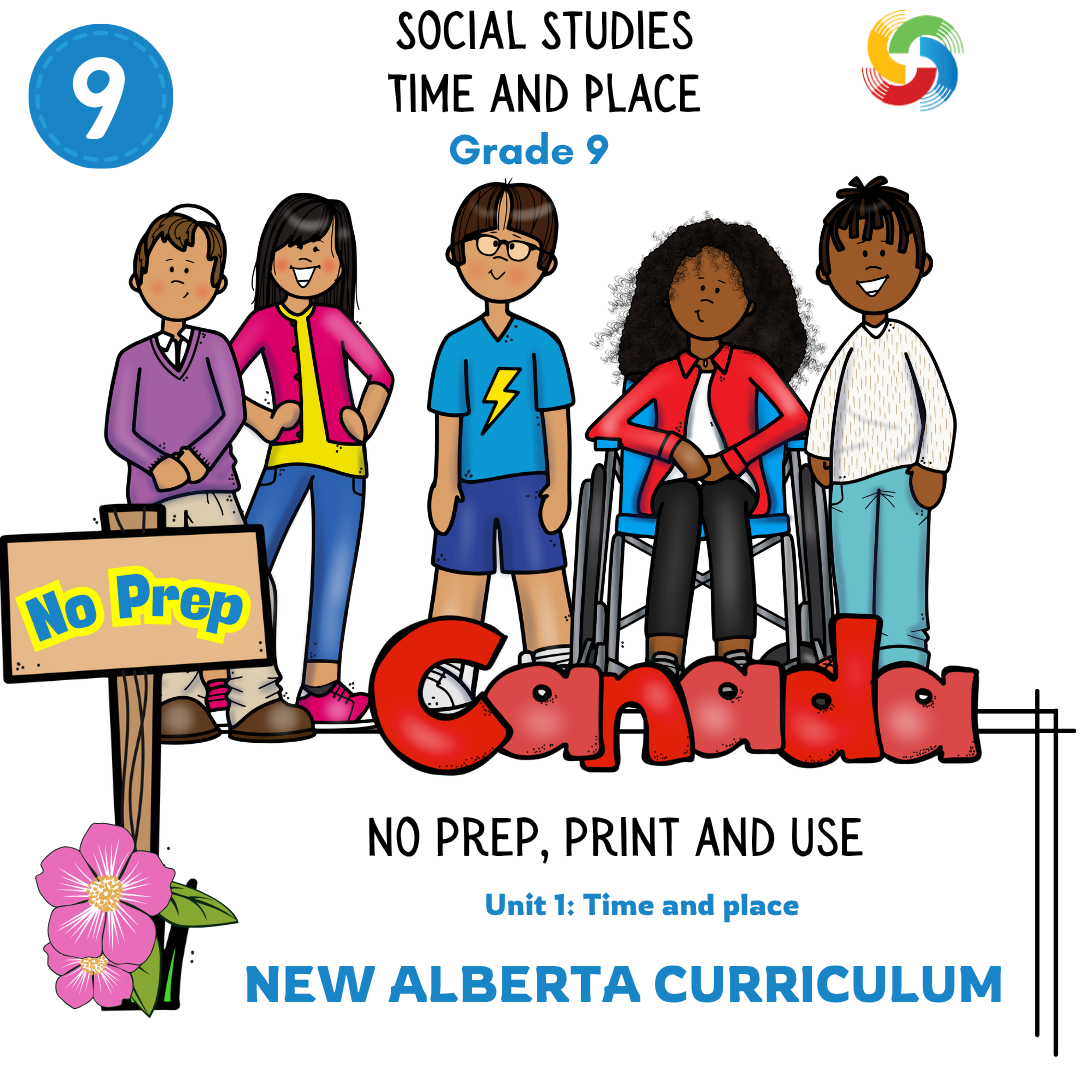
New Alberta Grade 9 Social Studies Curriculum 2025: Complete Time and Place Unit Now Available

The new junior high program of studies for Social Studies in Alberta is set for optional implementation in the 2026-2027 school year.

This is a 272 page book, designed to be the backbone of the new Time and Place section of the new Alberta grade 9 Social Studies program of studies. The book includes reading passages to teach the content, activities for students to engage in the learning process, and over 100 pages of teacher notes, grading advice, answer keys and exemplars.

 Every one of the KUSPs (Knowledge, Understanding, Skills and Procedures) is covered in this ideologically-neutral book.

Alberta Grade 9 Social Studies New Curriculum: Everything You Need to Teach Time and Place

If you are an Alberta Grade 9 Social Studies teacher right now, you already know the challenge. The new Alberta Social Studies curriculum launched with ambitious new outcomes, a completely restructured approach to content, and — if we are being honest — very few ready-made resources to support it. The previous curriculum had years of accumulated teacher-made materials, published workbooks, and shared resources. The new one has almost none of that yet.

That is exactly why I built this resource from scratch.

The Grade 9 Social Studies Time and Place Complete Unit is a comprehensive, fully curriculum-aligned workbook and assessment package covering every Knowledge, Understanding, Skills, and Procedures (KUSP) outcome in the Time and Place strand of the new Alberta Grade 9 Social Studies curriculum. And there is also a free companion vocabulary booklet — 94 key terms, student definition sheets, and a complete answer key — available at no cost.

Here is everything you need to know.


What Is the New Alberta Grade 9 Social Studies Curriculum?

Before we get into the resource itself, it is worth taking a moment to explain why this matters so much right now — and why finding quality resources for this specific curriculum is so difficult.

The new Alberta Grade 9 Social Studies curriculum is not a revision of the previous curriculum. It is an entirely new document with new organizing ideas, new content requirements, new inquiry questions, and a new framework for how students are expected to engage with historical and contemporary content. Teachers who have been teaching Grade 9 Social Studies for years are, in many respects, starting fresh.

The new curriculum is organized around three major strands. Time and Place — the strand this resource covers — is organized around three inquiry questions:

  • How can urbanization shift and shape a society?
  • In what ways can events transform a nation’s role in the world?
  • How successful has Canada been in building a cohesive nation?

These inquiry questions drive content that spans post-war Canadian immigration and urbanization, the growth of the oil and gas industry and its environmental consequences, Canada’s contributions to the Second World War including specific battles and diverse contributors, Canada’s post-war international role through the UN, NATO, and peacekeeping, conscription and the War Measures Act, regional identity and the National Energy Program, residential schools and the Truth and Reconciliation Commission, and the ongoing work of reconciliation with Indigenous peoples.

It is a broad, demanding, and genuinely important curriculum. It is also one for which almost no published resources currently exist.


Why Resources for This Curriculum Are So Hard to Find

If you have been searching for Alberta Grade 9 Social Studies new curriculum resources and coming up empty, you are not imagining it. Here is why.

Alberta curriculum resources typically develop over years. Publishers create textbooks. Teachers create and share materials. Professional learning communities build up a shared bank of lessons, activities, and assessments. All of that takes time — usually three to five years after a curriculum launches before a robust ecosystem of resources exists.

The new Alberta Grade 9 Social Studies curriculum does not have that yet. Teachers implementing it right now are largely doing so with whatever they can build themselves, adapt from the previous curriculum — which, again, covers substantially different content — or find through informal sharing networks.

This resource exists to fill that gap.


What Is Included in the Complete Unit

The Grade 9 Social Studies Time and Place Complete Unit is organized into three units and nine chapters, each covering a major section of the Time and Place curriculum outcomes.

Unit 1: Building a New Canada — Urbanization and Industry

Chapter 1: Coming to Canada — Immigration and Changing Demographics
Covers push and pull factors, post-war immigration waves, displaced persons and Holocaust survivors (1945-1951), and the transformation of Canadian cities into pluralistic, diverse communities. Students analyze the human dimensions of migration through reading passages, a push/pull factor sorting activity, a mapping activity, and a personal story analysis.

Chapter 2: Cities, Suburbs, and the Post-War Boom
Covers the baby boom, urbanization, suburban growth, public infrastructure development, the rise of the automobile, and the explosion of post-war consumption. Students build timelines, compare rural and urban life, and analyze the infrastructure demands of suburban growth.

Chapter 3: Oil, Hydro, and the Energy Economy
Covers the Leduc No. 1 discovery, the growth of Alberta’s petroleum industry, hydroelectric development including Hydro-Québec and the W.A.C. Bennett Dam, and the benefits and costs of Canada’s energy economy. Students conduct an oil sands case study, analyze stakeholder perspectives, and write a position paper.

Chapter 4: The Environmental Cost of Growth
Covers pollution, land consumption, land division, wildlife migration changes, habitat fragmentation, and the emergence of sustainable development as a response. Students map environmental impacts, analyze the urban sprawl case study of Ontario’s Greenbelt, and design a sustainable neighbourhood in the unit culminating task.

Unit 2: Canada on the World Stage — War, Peace, and Identity

Chapter 5: From Colony to Nation — Autonomy Between the Wars
Covers Canada’s WWI contributions and their impact on national identity, the Chanak Affair, the Balfour Report (1926), the Statute of Westminster (1931), and Canada’s independent entry into the Second World War. Students build a sovereignty timeline, analyze primary source excerpts, and write a cause-and-effect essay.

Chapter 6: Canada’s War — Contributions to the Second World War
Covers the Battle of the Atlantic, the Dieppe Raid, D-Day and Juno Beach, the liberation of France, Belgium, and the Netherlands, the defence of Hong Kong, the Italian campaign including the Battle of Ortona, and VE Day. Dedicated coverage of diverse contributions including Chinese Canadians in Force 136, Cree code talkers, and the Women’s Division of the Royal Canadian Air Force. Students create battle profile cards, analyze firsthand accounts, and design a gallery exhibition.

Chapter 7: Building a Peaceful World — Canada’s Post-War Role
Covers the founding of the UN, GATT, NATO, and NORAD, the Korean War including the Battles of Kapyong and Hill 355, the Suez Crisis and Lester B. Pearson’s invention of UN peacekeeping and Nobel Peace Prize, the Cyprus mission, and Canada’s reputation as a peacekeeping nation. Students complete an international organizations comparison chart, analyze the Suez Crisis from multiple perspectives, and prepare for a structured debate.

Unit 3: One Nation? Government, Identity, and Justice

Chapter 8: Unity and Division — Conscription, Emergency Laws, and Regional Identity
Covers conscription in WWI and WWII and its divisive impact on national unity, the War Measures Act and the internment of Japanese Canadians, the October Crisis of 1970, the Emergencies Act and its Charter protections, Quebec separatism and the 1980 and 1995 referendums, and the National Energy Program and western alienation. Students analyze the Japanese Canadian internment as a case study, compare the War Measures Act and the Emergencies Act, and examine regional identity perspectives.

Chapter 9: Assimilation, Reconciliation, and the Path Forward
Covers the Indian Act and enfranchisement policies, residential schools and day schools, the 1894 mandatory attendance amendment, the Sixties Scoop, intergenerational trauma, the Truth and Reconciliation Commission and its 94 Calls to Action, Section 25 of the Charter, the Canadian and Alberta Human Rights Acts, and government responses including apologies, compensation, and legislative change. Students trace intergenerational impacts, research TRC implementation, apply the Charter to a case scenario, and write the unit culminating argument.


The Answer Keys That Actually Help You Teach

One of the most distinctive features of this resource is the depth of its answer keys — and it is worth explaining why that matters so much for this particular curriculum.

When a curriculum is new, teachers do not yet have the accumulated professional experience that tells them what good student work looks like. They have not yet seen three years of student essays on the causes of Quebec separatism. They have not yet developed an intuition for what a strong analysis of the TRC’s Calls to Action sounds like from a Grade 9 student. They are building that knowledge while simultaneously trying to teach the content.

The answer keys in this resource are designed to support that process. For every open-ended question, every analytical activity, and every synthesis task, the answer key includes:

  • Complete reference answers for factual questions
  • Grading guides explaining what to look for in strong responses
  • Full exemplar responses for major written tasks — complete, high-quality sample answers written at a strong Grade 9 level
  • Partial credit exemplars showing what developing work looks like and how to distinguish it from proficient work
  • Rubric tables with criterion-by-criterion descriptors at four levels of achievement
  • Pedagogical notes explaining common student misconceptions and how to address them

This is not an answer key that tells you the right answer. It is a professional marking guide that tells you what strong teaching and learning looks like in this specific, brand new curriculum context.


The 50-Question PAE Practice Test

Every Grade 9 student in Alberta writes the Provincial Achievement Exam at the end of the year. The PAE tests content knowledge and analytical skills across the full range of curriculum outcomes.

The 50-question multiple choice practice test included in this resource is designed to reflect the format, difficulty level, and content distribution of the actual PAE. Questions are carefully written with genuine distractors — not trick questions, but real discriminators between surface-level and deep understanding. The answer distribution was randomized programmatically before any questions were written, eliminating the predictable answer patterns that make practice tests less useful as genuine assessment preparation.

The practice test can be used as a unit pre-assessment, a formative progress check, an end-of-unit practice exam, or a summative assessment tool.


The Free Vocabulary Booklet

Alongside the complete unit, there is a free 25-page vocabulary booklet covering all 94 key terms students need to understand fluently for the Time and Place unit and the PAE.

The booklet includes student definition sheets with writing space for all 94 terms, organized alphabetically, and a complete answer key with curriculum-aligned definitions written specifically for Grade 9 students — not dictionary definitions, but instructional definitions that situate each term in its Canadian historical context.

Teachers are using the vocabulary booklet as a unit-long note-taking tool, an exam preparation resource, a word wall reference, a differentiation support for students who need additional scaffolding, and a self-contained sub-teacher activity.

It is free. No strings attached. Download it, use it, share it with your colleagues.


The 20-Project Differentiated Menu

Not every student demonstrates understanding best through analytical essays. The resource includes a 20-project menu offering genuine choice — the majority of options involve significant creative components — while still requiring rigorous historical thinking and engagement with curriculum outcomes.

Projects include designing a museum exhibition on underrecognized WWII contributors, writing an illustrated graphic history of Canada’s path to sovereignty, creating a reconciliation report card evaluating Canada’s progress on the TRC’s Calls to Action, scripting a documentary film on the environmental costs of urbanization, writing a collection of fictional letters tracing the intergenerational impact of residential schools, and seventeen other options spanning oral history, policy analysis, simulation design, alternate history, and more.

Every project option includes a detailed grading guide with format-specific notes, suggested criterion weighting, and guidance on what distinguishes excellent from proficient work. A universal rubric allows consistent assessment across all twenty formats.


Full KUSP Outcome Coverage — Every Single One

This resource provides complete coverage of every Knowledge, Understanding, Skills, and Procedures outcome in the Alberta Grade 9 Social Studies Time and Place curriculum. Not most of them. Not the major ones. All of them.

That includes outcomes that are sometimes overlooked in resource development — the specific requirement to consider the benefits of the petroleum industry alongside its costs, the explicit naming of Chinese Canadians in Force 136, the Cree code talkers, the Women’s Division of the Canadian Air Force, the specific battles of the Korean War, the liberation of France, Belgium, and the Netherlands, land consumption and land division as distinct environmental outcomes, and the full treatment of Section 25 of the Charter and the duty to accommodate under human rights legislation.

If it is in the curriculum, it is in this resource.


Who This Resource Is For

This resource is for you if:

You are teaching the new Alberta Grade 9 Social Studies curriculum for the first time and you need a complete, ready-to-use unit that covers all the outcomes without requiring you to build everything from scratch while simultaneously learning new content.

You have been teaching Grade 9 Social Studies for years but recognize that the new curriculum is substantially different from what you have taught before and that your existing resources do not adequately cover the new content requirements.

You are a department head or curriculum coordinator looking for consistent, high-quality resources that multiple teachers in your school or district can use to ensure equitable coverage of the new curriculum outcomes.

You are preparing students for the Grade 9 PAE and want resources that are specifically designed to build the content knowledge and analytical skills the exam requires.

You believe your students deserve resources that take the new curriculum seriously — that engage honestly with Canada’s history of residential schools and reconciliation, that give genuine recognition to the contributions of Chinese Canadians, Indigenous soldiers, and women in the Second World War, and that ask students to think critically and form their own supported judgments about difficult historical questions.


A Note on the Content

The Time and Place curriculum covers some of Canada’s most important and some of its most difficult history. The residential school system. The internment of Japanese Canadians. Conscription. Western alienation. The near-breakup of Canada in 1995. The ongoing work of reconciliation.

This resource does not shy away from that history. The reading passages are honest about what happened and why it matters. The activities ask students to engage with multiple perspectives, including perspectives that are uncomfortable. The answer keys model the kind of nuanced, evidence-based thinking that difficult history requires.

At the same time, the resource is written for Grade 9 students — in language that is accessible, engaging, and age-appropriate, with activities that build understanding progressively rather than overwhelming students with complexity before they have the foundational knowledge to engage with it meaningfully.

The goal throughout has been to produce a resource that respects both the intelligence of students and the seriousness of the history they are studying.


Where to Find It

The complete Grade 9 Social Studies Time and Place unit and the free vocabulary booklet are both available on Teachers Pay Teachers.

Search: Alberta Grade 9 Social Studies Time and Place new curriculum

Or visit the store directly at [your TpT store link].

The complete unit bundle includes all nine chapters with reading passages, activities, and synthesis tasks; comprehensive answer keys with exemplars and grading guides; the 50-question PAE practice test; the 94-term alphabetical glossary; the 20-project differentiated menu with grading guides; and the universal project rubric.

The vocabulary booklet — 25 pages, 94 terms, student sheets and answer key — is free and available separately.


Frequently Asked Questions

Is this aligned to the new Alberta curriculum or the previous one?
This resource is written exclusively for the new Alberta Grade 9 Social Studies curriculum. It does not cover the previous curriculum’s content and is not compatible with the old outcomes framework. If you are still teaching the previous curriculum, this resource is not what you need — but if you are implementing the new one, it was built for exactly your situation.

Does it cover all three segments of the Grade 9 Social Studies curriculum?
This resource covers the Time and Place segment. The Systems segment and the Citizenship segment are separate resources. A Citizenship segment workbook is currently in development.

Can I use individual chapters rather than the whole unit?
Yes. Each chapter is self-contained and can be used independently. Teachers who are supplementing other instructional approaches rather than using this as a primary resource will find the individual chapters work well as targeted additions.

Is it editable?
The resource is provided as a PDF designed for direct classroom use and for copying into your own design platform. The clean formatting is designed with teachers who use Canva and similar tools in mind.

How long does the full unit take to teach?
The full unit is designed to cover a complete semester of Grade 9 Social Studies instruction. Individual chapters are designed to be teachable in approximately three to five class periods each, depending on the depth of discussion and the activities selected.

Is the vocabulary booklet really free?
Yes. Completely free. No follow-up purchase required.


Final Thought

Alberta teachers implementing the new Grade 9 Social Studies curriculum deserve resources that match the seriousness and ambition of what that curriculum is asking students to do. Building those resources from scratch — while simultaneously learning new content, managing assessment, and doing everything else teaching requires — is not a reasonable expectation.

This resource exists so that you do not have to do it alone.

Download the free vocabulary booklet. Take a look at the complete unit. And if you have questions, feedback, or requests for what you need next — the Citizenship segment is coming — reach out through Teachers Pay Teachers.

Your students are going to do important thinking this year. Let’s make sure they have what they need to do it well.


Tags: Alberta Grade 9 Social Studies, new curriculum 2025, Time and Place unit, KUSP outcomes, Grade 9 PAE preparation, Provincial Achievement Exam, residential schools Grade 9, Truth and Reconciliation curriculum, WWII Canada Grade 9, Canadian sovereignty, peacekeeping Grade 9, War Measures Act, Japanese Canadian internment, conscription Grade 9, urbanization Canada social studies, petroleum industry Alberta curriculum, push pull factors Grade 9, Juno Beach Grade 9, Force 136 Chinese Canadians, Cree code talkers, Women’s Division RCAF, Balfour Report Statute of Westminster, western alienation NEP, Quebec separatism Grade 9, Indian Act residential schools, Sixties Scoop, TRC Calls to Action Grade 9, Section 25 Charter, Alberta social studies teacher resources, free Alberta curriculum resources, Grade 9 social studies workbook Alberta


Pin It on Pinterest