
Grade 9 Time and Place Has Been Updated by Alberta Education: What Changed, and Why Your Students Aren’t Learning More Than Before
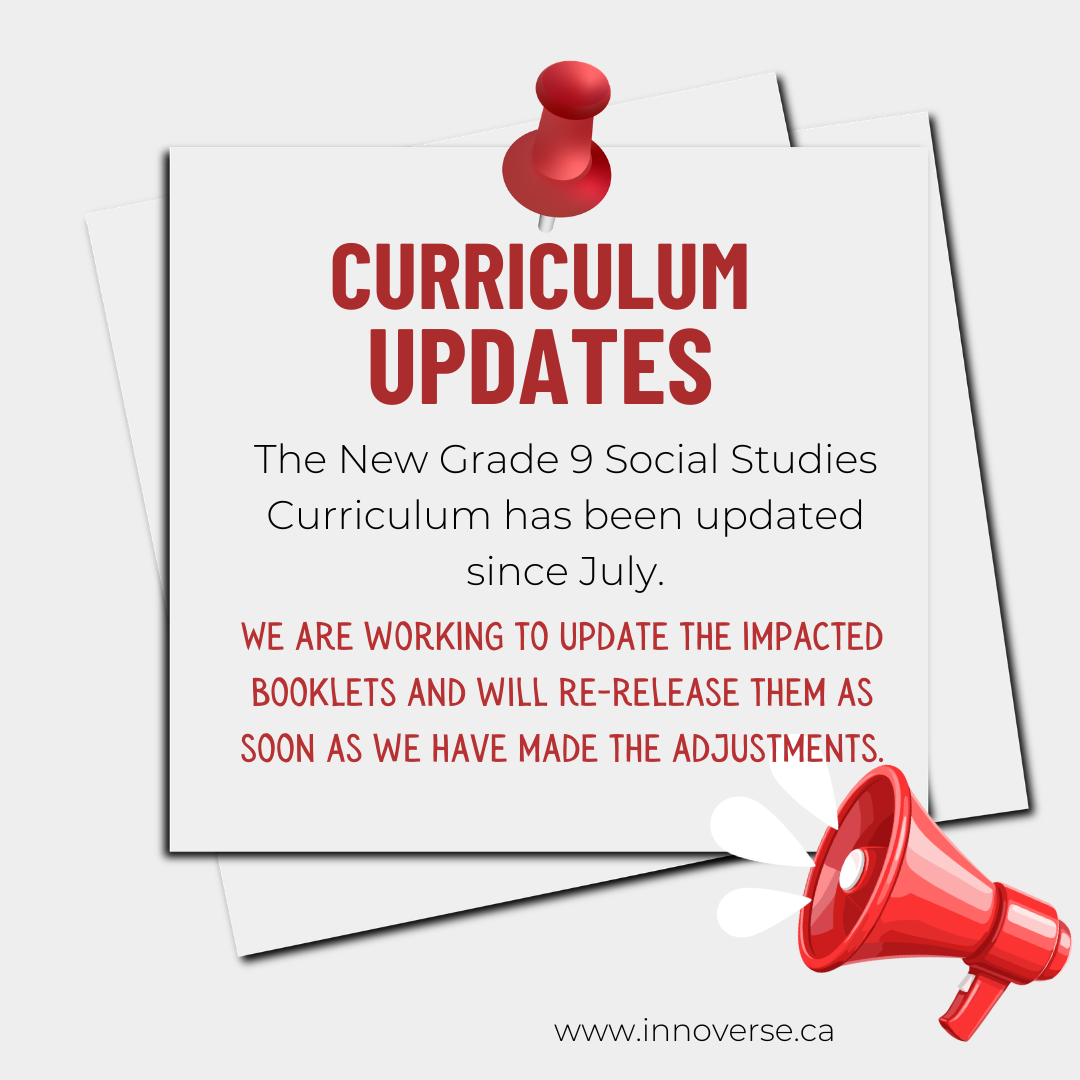
Alberta Education recently released an updated draft of the Grade 9 Social Studies curriculum, and the Time and Place theme saw real structural change. If you teach this segment, you deserve a clear, honest explanation of what shifted, and just as importantly, what did not.
We have already rebuilt the Time and Place workbook to reflect these changes, and the updated edition will be available before the school year begins in September. Every teacher who has purchased this resource will receive the update at no additional cost, consistent with our commitment to keep every booklet aligned as this curriculum continues to develop through its pilot year.
What Changed: Three Inquiry Questions Became Four
The original Time and Place theme was organized around three inquiry questions. The updated curriculum reorganizes that content into four. Two of those four questions are new to this theme specifically.
The first addition centers Canadian independence and expanded democratic rights, most notably the women’s suffrage movement and the Famous Five’s fight to have women legally recognized as persons under Canadian law. The second addition covers post-war political, economic, and social change in Canada, including the development of the welfare state.
At first glance, two new inquiry questions might sound like a meaningfully larger unit to teach. It is not, and here is why.
Why This Is a Reorganization, Not a Content Increase
When curriculum content moves, it is easy to assume something new was invented and added to an already full year. That is not what happened here. Nearly everything that now appears under Time and Place already existed within the Grade 9 Social Studies curriculum. It simply lived somewhere else.
The women’s suffrage and Famous Five content was already part of the Grade 9 program, previously situated within the Citizenship theme. Students were always going to learn about the Persons Case and the advocacy that led to it. That content has moved to Time and Place, not been created from nothing.
The same is true of the welfare state content. Healthcare and pension system development in postwar Canada was already addressed within the Systems theme. It has been repositioned under Time and Place as part of the postwar change inquiry question.
Multiculturalism and non-European immigration in the postwar period were already present within the Citizenship theme as well, and the Constitution Act, 1982 was already covered extensively there too, previously framed primarily through the lens of the Charter of Rights and Freedoms and reconciliation. Under the updated Time and Place theme, that same content is reframed as a milestone in Canada’s constitutional independence, which is a genuinely different lens worth teaching well, but it is not new subject matter for students to absorb on top of everything else.
What Is Actually New
To be fully transparent, a small number of genuine additions and refinements came with this update, and they are modest in scope. Postwar immigration content now explicitly includes non-European immigration waves from regions such as India, China, and Vietnam, rather than focusing primarily on European displaced persons as earlier drafts did. The Meech Lake Accord is now named as an explicit knowledge outcome rather than background context. Western alienation now explicitly includes Saskatchewan alongside Alberta.
None of these represent a new unit’s worth of instructional time. They are targeted refinements layered onto a body of content students were already going to encounter across their Grade 9 year, simply organized differently than before.
What This Means for Your Planning
If you are worried that this update means a heavier year, take a breath. The overall volume of what a Grade 9 student needs to learn across Time and Place, Systems, and Citizenship combined has not grown substantially. What has changed is where certain topics are taught and, in a few cases, the lens through which they are framed. That is a real adjustment worth taking seriously, but it is a manageable one, not a crisis.
We have done the work of tracing every one of these changes back to its source, confirming what content already existed elsewhere in the Grade 9 curriculum, and rebuilding the Time and Place workbook to reflect the update accurately. The revised edition preserves the reading passages and activities that were already strong, while integrating the reorganized content and framing so your students are covering exactly what the updated curriculum asks of them, without gaps and without redundant material duplicated across multiple workbooks.
When to Expect the Update
The updated Time and Place workbook will be released before classes begin in September, giving you the updated resource in hand well ahead of the school year. If you already own this workbook through Innoverse, the update comes to you as part of the ongoing alignment commitment behind every resource we sell. You do not need to purchase anything new.
I have spent thirty years in Alberta classrooms and hold a doctorate in Learning Sciences from the University of Calgary, where my research focused on the toll that constant curricular change takes on teacher workload. Tracking a mid-pilot curriculum revision so you don’t have to is exactly the kind of support that research pointed me toward building.
Where to Find This Resource
The updated Grade 9 Time and Place workbook, along with the full Systems and Citizenship workbooks, is available through Innoverse:
Shopify: www.shop.innoverse.ca
Teachers Pay Teachers: www.tpt.innoverse.ca
Website: www.innoverse.ca
If you have questions about how the updated curriculum affects your specific planning for the year, or want a closer look at how the reorganized content is structured in the new edition, reach out. This kind of transparency is part of what the update guarantee is meant to provide.
Innoverse creates curriculum-aligned instructional resources for Alberta teachers, actively maintained as Alberta’s curriculum renewal process continues. Learn more at www.innoverse.ca.