Key Concepts and Terminology in AI

Technojargon can be overwelming, not just for teachers, but for everyone. The world of artificial intelligence is no exception; it is a field filled with technical terms and definitions. Not all of the lingo is important for educators, but having a cursory understanding of the basics is probably worth the undertaking. Here we are going to take a look at some of the key terms and definitions pertinent to AI, in order to achieve a slightly deeper understanding of where we are at in 2023.

AIEd: short for Artificial Intelligence in Education, refers to the integration of artificial intelligence technologies into educational practices. It involves the use of AI-driven tools, algorithms, and systems to enhance and personalize the learning experience for students, streamline administrative tasks for educators, and provide data-driven insights for educational institutions. The application of AI in education (AIEd) has been the subject of research for about 30 years (Zawacki-Richter, 2019, p. 2).

Aigiarism: related to the concept of plagiarism, which refers to the practice of using someone else’s work or ideas without proper attribution or permission, aigiarism refers to using content entirely generated by artificial intelligence without acknowledging or attributing. In reading the literature, I have seen authors list ChgatGPT as a co-author, and I have read articles where the author opted not to formally name ChatGPT as a coauthor, with an explanation as to this choice.

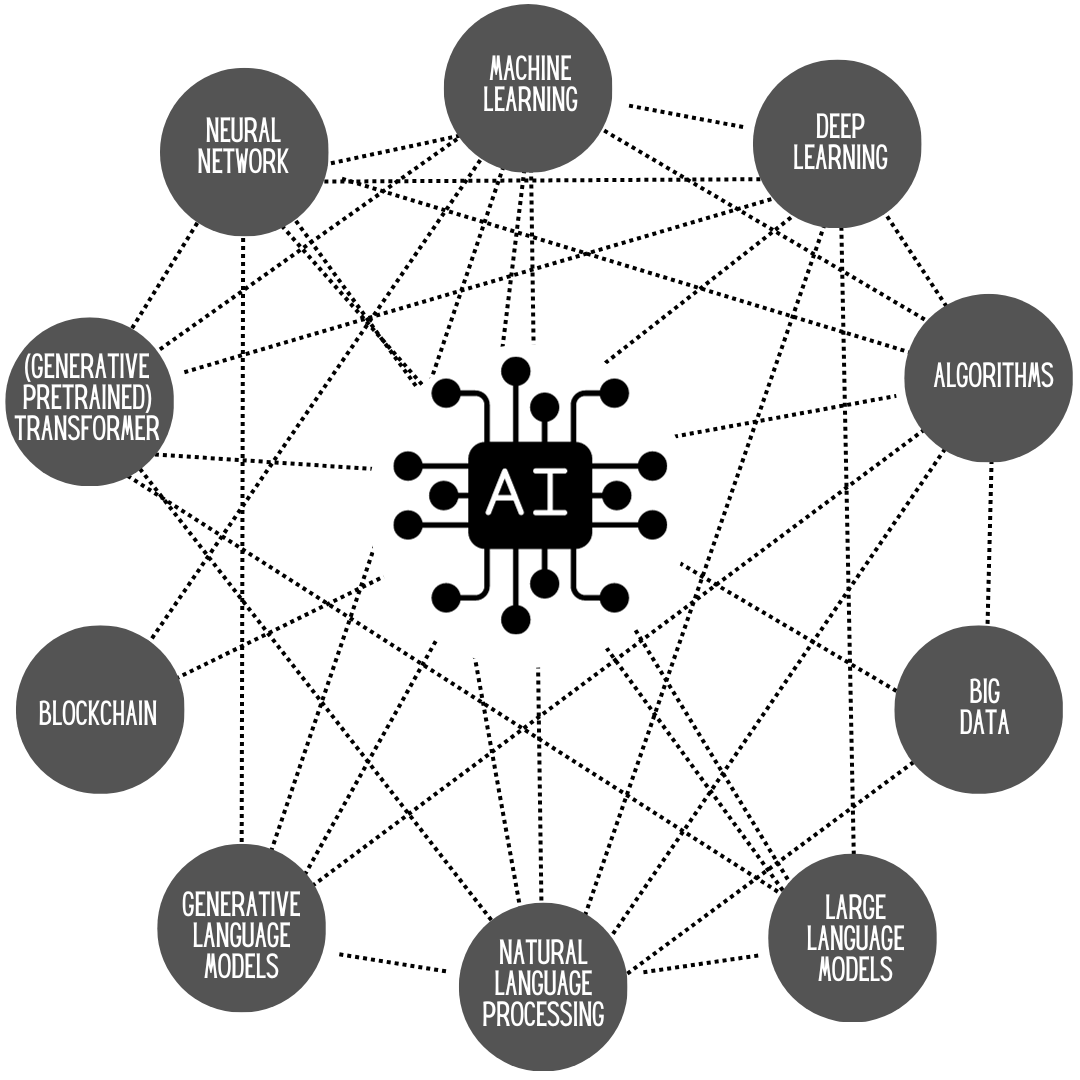
Algorithm: An algorithm is a set of step-by-step instructions or rules designed to perform a specific task or solve a particular problem. In the context of computer science and AI, algorithms serve as the foundation for various operations, including data processing, machine learning, and decision-making processes.

Big Data: Big Data refers to large and complex data sets that are challenging to process using traditional data processing applications. It encompasses vast volumes of structured and unstructured data that require advanced analytics and processing techniques to extract valuable insights, patterns, and trends.

ChatBot: an AI-powered computer program designed to simulate human conversation and interact with users via text or speech. The term “Chatbot” stems from “Chatter bot” coined by Michael Loren Mauldin for programs capable of text-based conversations with users (Chen et al. 2023, p. 162). Chatbots utilize natural language processing and machine learning algorithms to understand user queries, provide relevant information, and engage in meaningful conversations.

ChatGPT: ChatGPT is a Natural Language Processing (NLP) model developed by OpenAI that uses a large dataset to generate text responses to student queries, feedback, and prompts (Fuchs, 2023, p. 1). Tlili (2023) noted that ChatGPT is a conversational artificial intelligence interface which interacts in a realistic way and even answers “follow up questions, admits its mistakes, challenges incorrect premises, and rejects inappropriate requests” (Open AI, 2023)

Deep Learning: a subset of machine learning that utilizes artificial neural networks to process and analyze complex data. It involves the use of multiple layers of algorithms to extract high-level features from raw data, enabling machines to perform tasks such as image recognition, natural language understanding, and decision-making. The ability of computers to simulate what the brain does is called deep learning (Maboloc, 2023, p. 1)

Generative Artificial Intelligence: Generative Artificial Intelligence refers to AI systems capable of creating original content. GenAI models use advanced algorithms to learn patterns and generate new content such as text, images, sounds, videos and code  (Chan & Hu, 2023, p. 1). These systems use advanced algorithms, often based on deep learning models, to generate new data based on patterns and examples from existing datasets and they closely resemble human-generated content.

GPT: GPT stands for Generative Pre-trained Transformer, which is a type of deep learning model known for its ability to generate human-like text based on given prompts. GPT is a language model developed by OpenAI that is capable of producing response text that is nearly indistinguishable from natural human language (Lund & Wang,  2023, p. 26). GPT models are based on transformer architectures and have been widely used for various natural language processing tasks, including text generation, translation, and summarization.

Large Language Models: Large Language Models refer to advanced AI models designed to process and understand human language on a large scale. A language model is a type of AI model trained to generate text that is similar to human language (Lund & Wang,  2023, p. 26).These models utilize complex algorithms and extensive datasets to perform tasks such as text generation, language translation, and sentiment analysis.

Machine Learning: a branch of AI that focuses on developing algorithms and systems capable of learning from data and making predictions or decisions based on that data. Popenici and Kerr (2017) define machine learning “As a subfield of artificial intelligence that includes software able to recognise patterns, make predictions, and apply newly discovered patterns to situations that were not included or covered by their initial design” It involves the use of statistical techniques and iterative learning processes to enable machines to improve their performance over time.

Multimodal Models: Multimodal Models are AI systems that can process and interpret multiple types of data, such as text, images, and audio, simultaneously. These models integrate information from various modalities to gain a comprehensive understanding of the data and enable more sophisticated analysis and decision-making. Multimodal models (GPT-4) may produce voice and video explanations and tag images (Rahaman et al., 2023, p. 2).

Natural Language Processing Models: NLP Models are AI systems specifically designed to understand, interpret, and generate human language. These models use algorithms and linguistic rules to process and analyze text or speech data, enabling tasks such as language translation, sentiment analysis, and text summarization. Natural Language Processing (NLP) models have been in development since the 1950s (Jones, 1994), but it was not until the past decade that they gained significant attention and advancement, particularly with the development of deep learning techniques and large datasets (Fuchs, 2023, p. 1).

Neural Systems: Neural Systems refer to computational models inspired by the structure and functioning of the human brain’s neural networks. Neural systems mimic the human brain (Maboloc, 2023, p. 1). In the context of AI, neural systems are utilized for tasks such as pattern recognition, decision-making, and learning from data, often implemented through artificial neural networks.

Training Data: Training Data refers to the dataset used to train machine learning models and AI systems. It consists of labeled or unlabeled examples that enable algorithms to learn patterns, make predictions, and improve their performance on specific tasks. If the training data is not adequately diverse or is of low quality, the system might learn incorrect or incomplete patterns, leading to inaccurate responses  (Fuchs, 2023, p. 2).

Turing Test: The Turing Test is a measure of a machine’s ability to exhibit intelligent behavior that is indistinguishable from that of a human. Proposed by Alan Turing in 1950 who described the existence of intelligent reasoning and thinking that could go into intelligent machines (Crompton & Burke, 2023, p. 2), the test involves a human evaluator engaging in a natural language conversation with both a machine and another human without knowing which is which. If the evaluator cannot reliably distinguish between the machine and the human, the machine is considered to have passed the Turing Test. The Turing Test was proposed as a code of protocol to understand whether a machine can exhibit intelligent behavior equivalent to, or indistinguishable from, that of a human (Tlili et al., 2023, p. 2).
References

Chan, C. K. Y., & Hu, W. (2023). Students’ voices on generative AI: Perceptions, benefits, and challenges in higher education. International Journal of Educational Technology in Higher Education, 20(1), 43. https://doi.org/10.1186/s41239-023-00411-8

Chen, Y., Jensen, S., Albert, L. J., Gupta, S., & Lee, T. (2023). Artificial Intelligence (AI) Student Assistants in the Classroom: Designing Chatbots to Support Student Success. Information Systems Frontiers, 25(1), 161–182. https://doi.org/10.1007/s10796-022-10291-4

Crompton, H., & Burke, D. (2023). Artificial intelligence in higher education: The state of the field. International Journal of Educational Technology in Higher Education, 20(1), 22. https://doi.org/10.1186/s41239-023-00392-8

Fuchs, K. (2022). The importance of competency development in higher education: Letting go of rote learning. Frontiers in Education, 7, 1004876. https://doi.org/10.3389/feduc.2022.1004876

Lund, B. D., & Wang, T. (2023). Chatting about ChatGPT: How may AI and GPT impact academia and libraries? Library Hi Tech News, 40(3), 26–29. https://doi.org/10.1108/LHTN-01-2023-0009

Maboloc, C. R. (2023). Chat GPT: The need for an ethical framework to regulate its use in education. Journal of Public Health, fdad125. https://doi.org/10.1093/pubmed/fdad125

OpenAI. (2023). ChatGPT: Optimizing language models for dialogue. https://openai.com/blog/chatgpt.

Popenici, S. A. D., & Kerr, S. (2017). Exploring the impact of artificial intelligence on teaching and learning in higher education. Research and Practice in Technology Enhanced Learning, 12(1), 22. https://doi.org/10.1186/s41039-017-0062-8

Rahaman, Md. S., Ahsan, M. M. T., Anjum, N., Terano, H. J. R., & Rahman, Md. M. (2023). From ChatGPT-3 to GPT-4: A Significant Advancement in AI-Driven NLP Tools. Journal of Engineering and Emerging Technologies, 1(1), 50–60. https://doi.org/10.52631/jeet.v1i1.188

Tlili, A., Shehata, B., Adarkwah, M. A., Bozkurt, A., Hickey, D. T., Huang, R., & Agyemang, B. (2023). What if the devil is my guardian angel: ChatGPT as a case study of using chatbots in education. Smart Learning Environments, 10(1), 1–24. https://doi.org/10.1186/s40561-023-00237-x

Zawacki-Richter, O., Marín, V. I., Bond, M., & Gouverneur, F. (2019). Systematic review of research on artificial intelligence applications in higher education – where are the educators? International Journal of Educational Technology in Higher Education, 16(1), 39. https://doi.org/10.1186/s41239-019-0171-0

A Brief History of AI

The roots of AI can be traced back to the mid-20th century when researchers began exploring the possibility of creating machines that could simulate human intelligence. From the early days of simple problem-solving algorithms to the development of complex neural networks and deep learning models, AI has made significant strides in its evolution. It has transitioned from rule-based systems to data-driven approaches, unlocking capabilities such as natural language processing, computer vision, and autonomous decision-making. Over the years, AI has transformed from a theoretical concept to a practical reality, permeating various aspects of our daily lives and demonstrating its potential to reshape the future of education and beyond.

The birth of AI goes back to the 1950s when John McCarthy organised a two-month workshop at Dartmouth College in the USA. In the workshop proposal, McCarthy used the term artificial intelligence for the first time in 1956 (Russel & Norvig, 2010, p. 17) (Zawacki-Richter, 2019, p. 3), as he followed up on the work of Turing (Crompton & Burke, 2023, p. 2). Specifically, McCarthy’s use of the word “artificial intelligence” (AI) was intended to refer to machines and processes that imitate human cognition and make decisions like humans (Tlili, 2023, p. 1). There have certainly been lulls in the forward progress of AI since the coining of the term, and recent years have seen a significant change in artificial intelligence.

Currently, AI capability is developing rapidly (Sweeney, 2023, p. 2). At the end of 2022, Chat GPT developed by OpenAI was hailed as the most advanced intelligent machine closest to passing the Turing test, ushering in a new, vibrant era of artificial intelligence  (Yu, 2023, p. 02).

References

Crompton, H., & Burke, D. (2022). Artificial intelligence in K-12 education. SN Social Sciences, 2(7), 113. https://doi.org/10.1007/s43545-022-00425-5

Russel, S., & Norvig, P. (2010). Artificial intelligence – a modern approach. New Jersey: Pearson Education.

Sweeney, S. (2023). Who wrote this? Essay mills and assessment – Considerations regarding contract cheating and AI in higher education. The International Journal of Management Education, 21(2), 100818. https://doi.org/10.1016/j.ijme.2023.100818

Tlili, A., Shehata, B., Adarkwah, M. A., Bozkurt, A., Hickey, D. T., Huang, R., & Agyemang, B. (2023). What if the devil is my guardian angel: ChatGPT as a case study of using chatbots in education. Smart Learning Environments, 10(1), 1–24. https://doi.org/10.1186/s40561-023-00237-x

Yu, H. (2023). Reflection on whether Chat GPT should be banned by academia from the perspective of education and teaching. Frontiers in Psychology, 14, 1181712. https://doi.org/10.3389/fpsyg.2023.1181712

Zawacki-Richter, O., Marín, V. I., Bond, M., & Gouverneur, F. (2019). Systematic review of research on artificial intelligence applications in higher education – where are the educators? International Journal of Educational Technology in Higher Education, 16(1), 39. https://doi.org/10.1186/s41239-019-0171-0

Ways to use AI in K-12 Classrooms

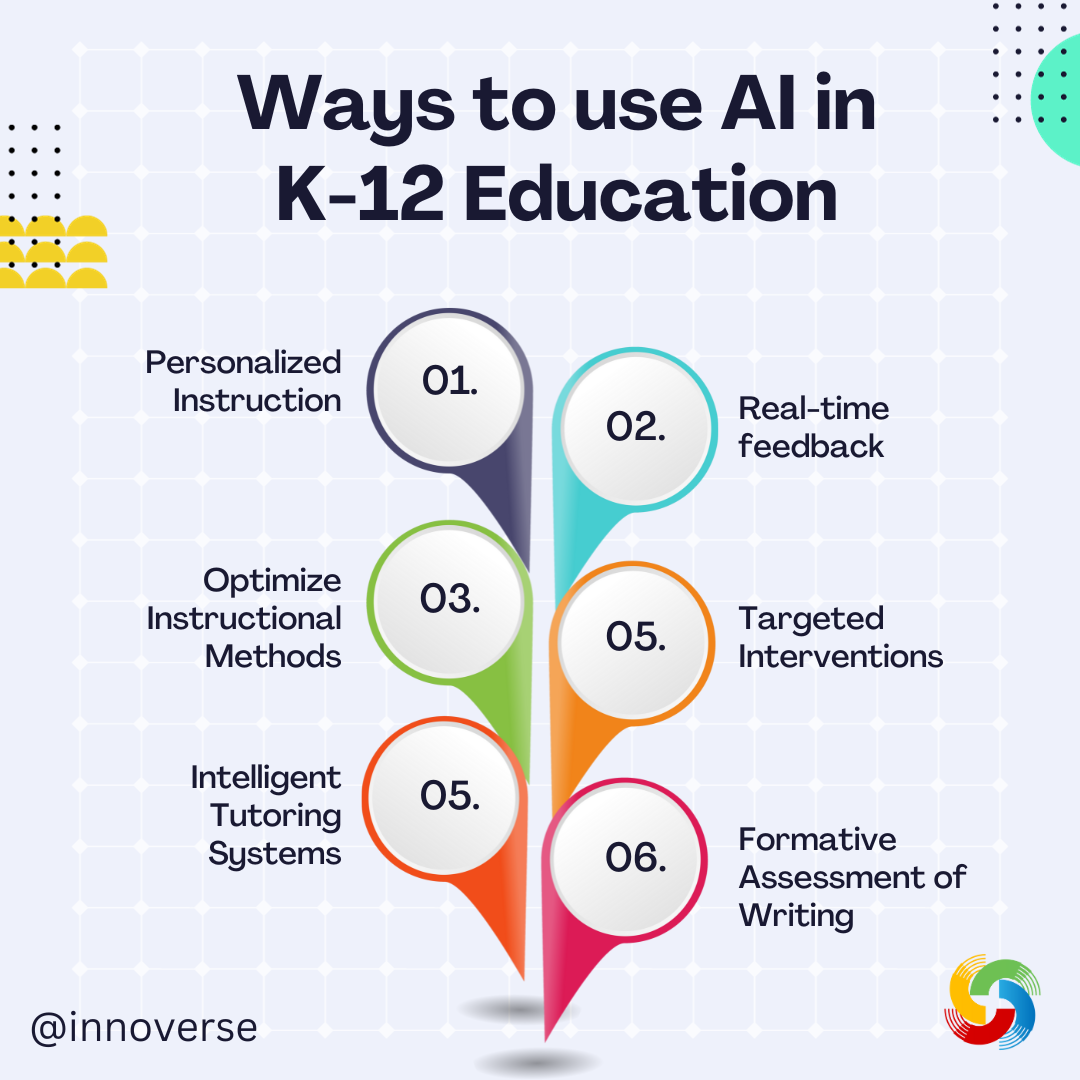
The empirical literature outlines a number of ways that artificial intelligence (AI) might be used in K-12 education. Despite these categories of use being identified as researchers as viable uses for AI in the K-12 classroom, many teachers are either unaware of these new resources, or they are unfamiliar with how to use these new tools, and the result is the same: at this time, they are either underutilized, or not utilized at all.

Regardless of the ubiquity (or lack thereof) of the use of these tools, we’ll  briefly outline some of the potential value that the academy suggests AI may bring to the K-12 environment.

Despite a paucity of research specific to K-12 education, the literature is filled with examples of uses for artificical intelligence in the K-12 classroom. For example, Holstein et al (2018) used Lumilo as mixed-reality glasses that allowed the educator to see the physical data of the student’s body language and also provided an additional digital layer over each student  (Crompton & Burke, 2022, p. 117).  AI programs, such as CyWrite, WriteToLearn, and Research Writing Tutor are being used to unpack and analyze student writing and provide feedback to the educator (Hegelheimer, et al. 2016). Crompton and Burke (2022) made reference to AI tutors literature review, noting that they provide one-to-one support for students, with tutoring matched to the student’s cognitive level followed by immediate, targeted feedback (Luckin, et  al. 2016). Examples of AI tutors include systems, such as ACTIVE Math, MAThia, Why2Atlas, Comet, and Viper which are used for a variety of subjects and grade levels (Chassignol et al. 2018). BERT, RoBERTa and XLNet are primarily focused on understanding the underlying meaning of text and are particularly useful for tasks such as sentiment analysis and named entity recognition  (Lund & Wang,  2023, p. 27).

So, the literature is currently outlining some uses for artificial intelligence that, in my estimation, and from my vantage point of working as the coordinator of educational technology, are not yet being used by teachers who are in front of our K-12 students. We are not going to endeavour to locate and test the affordances that are mentioned in the literature, but rather, we acknowledge that there is progress made in this area on a daily basis, and as applications involving artificial intelligence become more ubiquitous and/or more affordable, their usage will be inevitable in our K-12 classrooms worldwide.

References

Chassignol M, Khoroshavin A, Klimova A, Bilyatdinova A (2018) Artificial intelligence trends in education: a narrative view. Procedia Comput Sci 136:16–24. https://doi.org/10.1016/j.procs.2018.08.233

Crompton, H., & Burke, D. (2022). Artificial intelligence in K-12 education. SN Social Sciences, 2(7), 113. https://doi.org/10.1007/s43545-022-00425-5

Hegelheimer V, Dursun A, Li Z (2016) Automated writing evaluation in language teaching: theory, development, and application. Comput Assist Lang Instr Consort J 33(1):2056–9017

Holstein K, McLaren BM, Aleven V (2018) Student learning benefits of a mixed-reality teacher awareness tool in AI-enhanced classrooms. In: Rosé C, Martínez-Maldonado R et al (eds) Proceedings of the 19th International Conference on Artificial Intelligence in Education (AIED 2018). LNAI 10947 Springer, New York, pp 154–168

Luckin R, Holmes W, Forcier LB, Griffiths M (2016) Intelligence unleashed: an argument for AI in education. https://www.pearson.com/content/dam/corporate/global/pearson-dot-com/files/innov ation/Intelligence-Unleashed-Publication.pdf.

Lund, B. D., & Wang, T. (2023). Chatting about ChatGPT: How may AI and GPT impact academia and libraries? Library Hi Tech News, 40(3), 26–29. https://doi.org/10.1108/LHTN-01-2023-0009

Start at the Beginning

Let’s start at the beginning (more or less) with Artificial Intelligence in K-12 education. The starting point I will identify will be the launch of ChatGPT, as it is the point of awareness for the majority of the population of our planet, that AI has arrived, and it is here to stay. This is not to say that there have not been components of AI in K-12 education prior to ChatGPT, certainly, there have been. But ChatGPT ‘s launch represents a fundamental change in the way that AI is understood, viewed and mentally represented by the majority of people.

At the end of 2022, OpenAI launched a chatbot, named ChatGPT, that within five days attracted over one million users (Doshi et al., 2023, p. 6; Yu, 2023, p. 01). ChatGPT revolutionised people’s understanding of AI simply by being so very easy to use. The ChatGPT screen appears very similar to a search screen such as that of Google, but the space for the user to type in appears at the bottom of the screen. It also, unlike a search engine, provides some suggestions for the user in terms of interacting with the chatbot.

The layout of ChatGPT is so minimal, that it becomes obvious to new users how they are to proceed in order to interact with the artificial intelligence.

It’s important to know that the free version of ChatGPT (GPT-3.5 as shown at the top of the image), as of the date of this blog post, has been trained on data up to 2021. (The paid version, GPT-4 has been trained to a more recent point; According to the company who created ChatGPT, OpenAI, it has limited knowledge of world and events after 2021. The model has been trained on a diverse range of texts, including books, articles, and websites, allowing it to understand user input, generate responses, and maintain coherent conversations on a wide range of topics  (Chan & Hu, 2023, p. 2). When you ash ChatGPT a question, you receive a response that reads as smoothly as if a human had considered your question and took time to craft a response. Without taking a deep dive into the technical details, it is worth noting that the chatbot called ChatGPT was trained using more than 175 billion parameters (Chan & Hu, 2023, p. 2). This massive training is how, despite that it is actually not connected to the Internet (OpenAI, 2023), it is able to construct responses that “feel” human.

References

Chan, C. K. Y., & Hu, W. (2023). Students’ voices on generative AI: Perceptions, benefits, and challenges in higher education. International Journal of Educational Technology in Higher Education, 20(1), 43. https://doi.org/10.1186/s41239-023-00411-8

Doshi, R. H., Bajaj, S. S., & Krumholz, H. M. (2023). ChatGPT: Temptations of Progress. The American Journal of Bioethics, 23(4), 6–8. https://doi.org/10.1080/15265161.2023.2180110

OpenAI. (2023). What is ChatGPT? https://help.openai.com/en/articles/6783457-what-is-chatgpt

Yu, H. (2023). Reflection on whether Chat GPT should be banned by academia from the perspective of education and teaching. Frontiers in Psychology, 14, 1181712. https://doi.org/10.3389/fpsyg.2023.1181712

Researching AI in Education

 My blog has been quiet for a while. I’ve been grappling with my research ideas, and passions. So much so, that I have come to term this phase as my mid-degree crisis. I’ve made the decision to change my focus to a currently pressing topic in education; Artificial Intelligence.

I am still sussing out the actual research question, but I want to try to look at this new tool/resource as more than just a new challenge to the classroom, but rather through a lens of teacher wellness. How can we use this new tool that is growing more ubiquitous by the day to perhaps take something off the plates of teachers? 

These are the conversations I am hoping to have with teachers this school year while I work through the literature review portion of my dissertation, and hammer down the official research question and associated methodologies.

Research – Preliminary thoughts

My research topic is an evolving decision. I have entered my doctoral program with a number of potential research interests. As I’ve already blogged, the one that keeps coming back around is the concept of strengthening the teacher-student relationship with the use of technology. 

I have a loose hypothesis in my head that there is something to the one-on-one nature that certain digital technologies can offer that relationship. I’ve seen it play out positively a few times over recent years, and I feel like there is more there than meets the eye. Of course, it has issues such as boundaries, appropriateness of communication and the documentation of these things, but those topics can be more broadly tackled as my research unfolds.  For the summer of 2022, I am starting by taking a step back to first look at the teacher-student relationship, and the pedagogical role it plays. Then I will open it up slightly to include digital technologies as they have been previously used and studied.

Research Interest

As I reflect on my research, I realize that my passions have evolved organically from over two decades spent in the classroom in K-12 learning.

I am specifically interested in using technology and ubiquitous connectedness to improve the teacher-student relationship.

To get to that place, I need to take a few steps back, and find out what the literature tells us about the importance of that relationship in the career as “Teacher”. I know from my 23 years in the classroom that the relationship between the teacher and each student is important, and any steps that can be taken to improve the quality of that connection will improve outcomes for the student.

But I do not know the specifics of this. Does a good relationship with the teacher improve academics? Does it change in-class behaviour? Does it alter the student’s commitment to the classwork? Are there any changes to out-of-class behaviours such as homework completion or test studying?  My initial research needs to seek answers to these questions.

I realize that as I read the literature, and as I find answers or partial answers to that early list of questions, I am likely to have more questions emerge. This is a journey, and I am only setting my feet onto the first part of this path. The years ahead will reveal the clarity of where this path will go.

That said, the next phase of my inquiry will move into the teacher-student relationship when there is a screen involved. Two years ago our planet was thrust into a circumstance of emergency online learning, and the relationships that had existed in the face-to-face classroom were moved online. Teachers were not prepared for this shift, but with grit and perseverance, they did their best to make it work. Clearly there is data to be found in the pandemic reality; some data may be relevant to my research.

As of today, my interest for my doctoral research will in some way fall into the idea that perhaps teachers can leverage the power of technology, and mobile technology to improve the quality of their relationships with their students. I have personal experience as a teacher that suggests there may be something to learn here; I’ve additionally seen this play out with other educators, so now I want to know more. Actually, I need to know more.

The way that we use our technology continues to evolve. What was the intended use for a particular technology when it was first deployed may not be the way that it actually used once it is in the hands of humans. An illustrative example of this would be Facebook. It was designed for humans to connect to and communicate with other humans. However, it did not take long before businesses were starting Facebook profiles to connect to their clients. The programmers at Facebook had to reenvision the product, and “pages” and “groups” were created to address this style of usage.

I think this is a topic worth researching because we live in an interconnected world, and at times, technology can create the perception of a more distracted or distant relationship to others, yet we are more connected to others than we have ever been. How can we utilize the mobile technologies that we regularly engage with to better support learners, and to facilitate stronger relationships? We know that the relationship between teacher and student is important, but some students can be difficult to build rapport with. Can digital technologies bridge any of those gaps? Can mobile technologies strengthen positive relationships? Can they provide the starting point for relationships with students who present greater challenges in our classrooms? How can we harness the power while mitigating the risks?

Song, H., Kim, J., & Luo, W. (2016)

When Song, Kim, and Luo (2016) conducted their research into the role of teacher disclosure in the teacher-student relationship in online classes, they conducted their work in a mid-western American university, surveying 534 undergraduate students. They demonstrate by citing previous research that it is well understood in education that the teacher-student relationship is an important factor in student success. To acquire accurate data for their analysis, they selected one aspect of teacher interpersonal communication; self-disclosure, and to obtain data regarding learning they focused on two dependent variables; the perceived knowledge gain and class satisfaction of the students. They used an identical questionnaire for face-to-face (FtF) learners as they did with online learners in order to compare the two environments in a compatible manner. To further strengthen the robustness of the data they were seeking, participants were recruited from only large introductory communication courses. Age was included as the control variable.

The first survey was conducted with a focus on face-to-face learning, and they note that among the survey respondents there were more females than males with the ratio being approximately 70% females. The second survey was conducted a semester later and focused on online learners. The same survey was administered to the online learners (this time the female percentage was only 55) a semester later. The sample groups were comprised of different students so as to avoid test sensitization. Most students in the sample had taken both online and FtF classes at the college where the study took place, allowing researchers to make systematic comparisons of the two environments. 

Findings of their study revealed that the impact of teacher self-disclosure on teacher-student relationship is stronger in online classes as compared to face-to-face classes. They assert that it has a higher implication in the online environment because there are reduced cues is the remote environment that facilitate easy and natural self-disclosure. Their statement “online environments [that] may preclude teachers from revealing even basic information such as demographics (e.g., age, ethnicity), voice or personality, which can be readily available in FtF classes” (p. 441)  indicates that no video lectures are factored in to their definition of online learning, neither in the form of flipped classroom pre-recorded lectures, nor through video conferencing applications such as Skype or Zoom. They also explicitly stated that their data showed that teachers disclose themselves significantly less online than they do in the FtF classroom. 

This research was novel in that the majority of previous research on topics of relationships in the online environment was completed using applications whose main purpose was the forming of relationships (social networking sites or dating sites). As online classes are not generally centered around the building of relationships, there was a gap in the research that Song et al. have begun to fill in with this study. 

Their study suggests that teachers should be mindful of the absence of their personal self-disclosure in the online classroom in order that they take deliberate steps to include this critical piece of human interaction when instructing in the online environment. They do not suggest what type of information should be revealed in order to facilitate this disclosure and subsequent relationship improvement. They also acknowledge that this area is one that requires further study.


References

Song, H., Kim, J., & Luo, W. (2016). Teacher–student relationship in online classes: A role of teacher self-disclosure. Computers in Human Behavior, 54, 436–443. https://doi.org/10.1016/j.chb.2015.07.037

How do we Learn?

This was a tough first assignment; I truly do not know the answer. So here is my best shot at it as of today.

Learning is a complex, multi-sensory, brain activity that involves the writing of data into the synapses of our brains. Learning involves relationships and connections; both between the learner and the content, as well as between the learner and the instructor. We learn when something becomes meaningful to us; when something is situated in our lives and when the relevance is obvious, we are predisposed to learn. In the absence of the situation, learning can occur, but it is generally shallow, facile and largely temporary. When we engage with contextually relevant material, we are hard-wired to learn. The moment we take our first breath after birth, learning begins. Infants know nothing beyond communicating, (with one tool only, a cry), their most basic of needs. But the processes of learning commence immediately at birth. Our senses engage with the world around us, and each time we encounter something new, we observe, we categorize, we connect, we label, and we write the data, both the correct and incorrect data, to our memories.

Learning is not solely a rational process. Emotion influences motivation, which influences learning. Maslow before Bloom. If the bottommost needs from Maslow’s pyramid are not being met, educators observe that the child (or adult) is not available to learn. So we try with breakfast programs and other supports to maximize the odds of all children being equally ready to learn.  It’s infinite combinations, working in infinite patterns, while we try to discern how they tie together.

Password Protect Quizzes in Google Forms

If you are giving a Google Forms assessment to multiple classes, security is a consideration. Different teachers approach this security differently, but it is worthwhile noting that Google Forms can be password protected to limit students’ ability to access the form before you want them to have access.

This video is an example of not being able to go through the door when it comes to tech, but rather finding a window by which to accomplish the desired task.  There is no button to toggle to password protect your forms assessments, but if you follow the easy and innovative process shown in the below video, you will have a new level of security to apply to your assessments!!

Let’s go in Through the Window

Unique Google Classroom Banners

This page contains affiliate links. You can read my disclosure here.

I am pumped to let you know that I have built an assortment of Google Classroom Banners for you to use to customize your Google Classrooms with some different images than the default images that Google offers.

It is important to understand that when you change the banner in Classroom, it is going to appear a fair bit darker than the way it appears in Google Drive. This is an assistive technology in action, as the darker tone makes classroom much easier to see, read, and engage with for students with vision challenges.  This cannot be changed, and likely (hopefully) is not something Google would entertain changing.

The new banners can be found in the Freebies area of this site.  There are other useful resources there as well that you may find you have a good use for. So, please, anything you find in that site that catches your attention – feel free to take a copy!!

Below is a small sampling of the Google Classroom banner resources I’ve created.

Distance Learning Tips for Parents

One would think that after 22 years in the classroom, 25 years in education and with a Masters degree in Educational Technology that I’d have the whole parenting a digital student thing figured out. I’m here to tell you that this is not the case!! I have spent the past 12 months navigating online learning for my middle-schooler, and I have certainly found myself up against all the challenges of playing this role!

Late assignments, missed assignments, half-hearted effort, oversleeping, procrastination – I’ve seen them all in the past twelve months!!

I am fortunate to be married to an educational psychologist (also my child’s father, we are not a blended family) and so we parent together with significant knowledge, training, experience, and understanding of the brain development of children.  Brain development is our biggest philosophy in terms of parenting choices. 

In late February 2021, I hosted an evening session for parents of online students in my school jurisdiction. It was an excellent exercise to put myself through the process of thinking about my own experience as a parent of a virtual student, and to put my experience and knowledge into a cohesive presentation.

I also created a companion booklet with a couple of printable workbook pages at the back for parents to use to cover the topics I spoke about in my evening presentation. 

So, parents, here is a recording of the presentation, and you are most welcome to print the above-linked booklet should you wish to have a copy.


How to Record Audio for Students with Learning Disabilities on a Chromebook

I was wrong!

The first time I took a look at Mic Note for recording audio clips to assist our students who struggle with reading or have written language or other disabilities, I thought that it was clunky and awkward.

After much searching for a perceived better option, and coming up blank, I returned to Mic Note, only to realize that I was wholesale wrong about it.  It offers more than just audio recording, which is amazing!

Among my first misconceptions was my assertion that it was difficult to record in .mp3 format, and awkward to direct to Google Drive. Wrong.  If you are wanting to learn how to record your voice on a Chromebook, this app is what you’ve been seeking!

The key advantages it offers over other audio utilities are important details for educators.

Firstly, it allows for up to four hours of recording time. None of us require that much for school uses, but we definitely need more than 5 or 10 minutes as the outer limit, which is where most other applications cut the recording off.  Some sources for exams take longer than 10 minutes to read aloud.

Secondly, it can be set to store the recordings directly into your Google Drive, making them yours forever. This is another advantage over the “competition”. There are some decent applications out there – Talk & Comment and Vocaroo come to mind right away – but they store your audio on their server and delete it after an amount of time has passed. This means that for all the time it takes to record the audio, a year down the road when you wish to reuse the resource with your students, you no longer have access to your recordings from last year, or even last semester. That’s no good!

Thirdly, Mic Note allows you to edit your audio as you are in the process of recording. So, if you get your tongue in a knot reading aloud, and you need to try again, Mic Note facilitates this easily.

So, I hereby retract my earlier position about Mic Note, and I highly recommend it.

Here’s a video outlining how I recorded an English 30 exam for students requiring the accommodation, and the templates for the two exam booklets can be copied to your Google Drive through the freebies section of this website!

Google Classroom Changes Coming for Fall

Google is rolling out some fantastic changes to Google Classroom with the expectation that they will be up and running for fall 2021.  Keep providing your suggestions to Google via the question mark icon in the bottom left corner of Google Classrom; we have more proof that the Engineers at Google are listening to us!

Student Data

Perhaps the most exciting of the new features is the improvement to the student metrics. In the updated Google Classroom, teachers will be able to see when a student was last active in Google Classroom, what and when their last submitted assignment was, as well as the most recent comment (which are often questions from students) from students.

This feature is a class-by-class feature that will provide teachers with some excellent data for both in-person learning as well as online!

Improved Photo Tools in the Google Classroom app

Thanks, in large part, to feedback from teachers around the world using Google Classroom, they are adding camera access inside the Google Classroom app. So, students who operate their Google Classroom through their phone will be better equipped to photograph (it will be built more as a scanning type app that utilizes the phone’s camera) completed work and easily submit it to the teacher for grading.  At first, this will only be on Android devices, but will come to Apple devices once the Android app is running smoothly with this new feature.

Offline Mode

Many of our rural students who live in areas with limited wifi access already use offline mode with their Google Drive. Now this feature is going to include Google Classroom. Students will be able to access classroom while at school, and then when they get home, their device will have retained the data to allow them to have access to this important data while at home, or away from wifi.

Originality Reports

Teachers and students will both have access to enhanced originality reports. Students can run a report prior to submitting a written assignment so as to have clarity as to the success of their personal writing.

Rubrics

The creation of rubrics in Google Classroom has also improved – teachers can now export their rubric to sheets, or import a rubric from sheets.

Full Webinar

Below is the full 30-minute webinar that Google offered this morning to bring us all up-to-date with respect to the changes to Google Classroom!

Google Classroom Information for parents

As we have weathered the past year of quarantine, the primary learning management system to communicate school work to students at home has rapidly become Google Classroom. Here are a few things you should know about being a parent of a “Google Classroom Kid”…

Parents do not have a login for Google Classroom. Only students can be added to Google Classroom.

This does not mean that you are to remain uninformed. Classroom keeps parents informed via email. To receive the emails, parents can provide an email address to their child’s teacher, and the teacher will add the parent into the student roster through the child’s identity in Classroom. At this point, Google will deploy an email to the address provided to the teacher, and parents must accept the invitation.

Once parents have accepted this invitation, Google Classroom will send regular email summaries to the email address provided. Parents then have the choice to have Classroom send daily summaries, weekly summaries, or no summaries. You will get ONE email per child, regardless of how many teachers each child has. 

What you can expect to see in your summary email is

  1. Missing work—Work not turned in when the summary was sent.
  2. Upcoming work—Work that’s due today and tomorrow (for daily emails) or that’s due in the upcoming week (for weekly emails).
  3. Class activities—Announcements, assignments, and questions recently posted by teachers.

What you cannot expect to see are your child’s grades. To see your child’s grades, parents will log in to Powerschool or the SIS database your jurisdiction offers..

Additionally, we have also recorded a video suited to teachers and parents regarding how to add parents to Google Classroom without violating privacy laws. The video shows the entire process, including what both parties will see on their individual screens.

Need more Details?

We recommend that parents wanting to access the details of their child’s Google Classroom should sit with the child and ask for a “tour” of Google Classroom. This accomplishes a few things.

  1. It lets you, the parent, know how comfortable and confident your child is in the Google Classroom environment.
  2. It lets you, the parent, view the formative assessment comments that your child’s teacher may have made with respect to the child’s work.
  3. It facilitates a conversation with your child about their schoolwork and their online experience.

As educators, we would say that the third point above is the most important point, and often, this is a topic that parents struggle to get their child to open up about. (“How was school today?” “Fine.”) Sitting beside your child and talking about the content, work, assignments and grades in each course will facilitate this discussion without forcing you, the parent, to feel like you are prying and getting no actual information.

If you have questions about what you read in the email summaries, or what your child shows you in Google Classroom, please reach out to your child’s teacher/teachers for clarification.

Pin It on Pinterest